
GILC Convenes World Leaders on Social Connection and Division During Global Loneliness Awareness Week

WASHINGTON, June 10, 2026 (GLOBE NEWSWIRE) -- Each June, Global Loneliness Awareness Week turns public and institutional attention toward what researchers and policymakers now describe as one of the most consequential and least addressed challenges of our time: the collapse of social connection. This year, the Global Initiative on Loneliness and Connection (GILC) marks the week the way it approaches every dimension of its work: by producing tools, convening leaders, and building the global infrastructure that a more connected world requires. The centerpiece is the Global Connection Forum on June 17, bringing together senior leaders across public health, policy, philanthropy, and civic systems around a question with consequences well beyond the political: what heals division?
A Crisis of Connection, Not Just of Politics
Loneliness and social isolation have emerged as defining public health challenges of the current era, with consequences that extend far beyond individual wellbeing. According to meta-analyses by Dr. Julianne Holt-Lunstad, cited in the 2023 U.S. Surgeon General's Advisory on Social Isolation and Loneliness, chronic disconnection increases risk of serious illness by 26 to 28 percent, and people with strong social ties have a 50 percent greater likelihood of survival compared to those who are more isolated. The economic toll is equally documented: research from Cigna estimates employee social disconnection costs employers roughly $159 billion annually in lost productivity, while a University of California San Francisco study put excess Medicare spending linked to social isolation among older adults at approximately $7 billion per year.
What research has made increasingly clear is that loneliness and social isolation are not the same condition, and treating them as interchangeable has contributed to responses that miss the mark. Loneliness is a subjective experience, the felt sense of lacking meaningful connection. Social isolation is an objective state, a measurable deficit in social contact. Both carry serious consequences, but the structural conditions that produce them, and the policy tools required to address them, are distinct. This distinction sits at the center of GILC's work and at the heart of the forum's agenda.
Polarization, too, is increasingly understood not as a values problem but as a relational one. When the social infrastructure that allows people to build trust across difference erodes, so does the capacity for shared civic life. Division follows disconnection. GILC's position, grounded in more than a decade of cross-sector research and global coordination, is that social connection is not peripheral to the challenge of a fractured society. It is the structural condition on which repair depends.
The Global Connection Forum: June 17, 2026
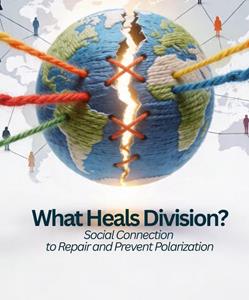
The 2026 Global Connection Forum, themed "What Heals Division? Social Connection to Repair and Prevent Polarization," takes place online from 8:00 to 10:30 PM UTC. The event is structured as an action-oriented convening, built around cross-sector partnerships, aligned funding priorities, and concrete implementation strategies rather than general dialogue.
The agenda opens with a state of the field address by Dr. Johanna Badcock, GILC Co-Founder and Board Chair, and a World Health Organization update from Dr. Alana Officer, Unit Head for Health Promotion, Social and Economic Determinants. Professor Netta Weinstein of the University of Reading will present research on depolarization and social wellbeing. Panels draw on practitioners from the RAND Corporation, More in Common US, and Search for Common Ground, examining truth decay, cross-divide movement building, and collaborative leadership as pathways to restoring civic trust. A member spotlight from ThriveWell examines depolarization work underway in Malaysia, reflecting the scope of GILC's 35-country network.
Structured catalyst breakout sessions close the main program, organized around awareness, policy and advocacy, practice, and research. The forum will also mark the launch of GILC's inaugural Early Career SILC Researcher Award, presented by Dr. Julianne Holt-Lunstad, whose meta-analyses established social disconnection as a mortality risk factor on par with smoking and whose work contributed directly to the 2023 U.S. Surgeon General's Advisory on Social Isolation and Loneliness.
"Division, whether cultural or political, does not begin with bad values. It begins with broken infrastructure. When communities lose the conditions that make it possible to know one another across difference, to build trust, to show up, the fractures that follow should surprise no one. Social connection is the salve. But it has to be built deliberately, the way we build roads and schools and health systems, because it will not happen on its own," said Edward Garcia, Co-Founder and Operational Lead of GILC.
Tools, Forums, and Movements: GILC's Field-Building Role
The forum is one expression of how GILC operates. The organization does not wait for consensus to form on its own. It builds the conditions for consensus: field resources that give practitioners and communicators a shared evidence base, global convenings that move leaders from strategy to commitment, and coordinated campaigns that align the work of member organizations across more than 35 countries toward common goals.
That coordination runs through the SILC Coordinating Council, which aligns GILC with the WHO, OECD, European Union, and Royal Society of Arts on shared measurement frameworks and policy standards. GILC's position statements on loneliness and social isolation, developed over 18 months with its global membership and an International Scientific Board of more than 600 researchers, have been adopted and referenced by the World Health Organization. The field is moving. GILC exists to make sure it moves together.
About the Global Initiative on Loneliness and Connection (GILC)
The Global Initiative on Loneliness and Connection (GILC) is a global network of organizations working to advance social connection through policy, research, and practice. GILC serves as a neutral convener, bringing together diverse stakeholders to align on shared challenges and accelerate progress across more than 35 countries. GILC is a registered 501(c)(3) public charity (EIN: 87-3476184).
Contact
Edward Garcia
Global Initiative on Loneliness and Connection
edward@gilc.global
A photo accompanying this announcement is available at https://www.globenewswire.com/NewsRoom/AttachmentNg/ce54216f-c674-499e-8ae1-4267a45b0716

Cover Image
GILC Convenes World Leaders on Social Connection and Division During Global Loneliness Awareness Week
Legal Disclaimer:
EIN Presswire provides this news content "as is" without warranty of any kind. We do not accept any responsibility or liability for the accuracy, content, images, videos, licenses, completeness, legality, or reliability of the information contained in this article. If you have any complaints or copyright issues related to this article, kindly contact the author above.
