

Global Seaweed Powder Market Set to Reach $369.36 Million by 2033, Propelled by Food & Beverage Reformulation and Cultivated Sourcing Expansion – Verified Market Research
Rising demand for clean-label functional ingredients, advances in cultivation and processing technology, and tightening regulatory quality frameworks are reshaping the Global Seaweed Powder Market. Spanning food and beverage reformulation, animal feed, agriculture, and cosmetics, the industry is transitioning from niche sourcing to scalable, specification-driven procurement. Verified Market Research® projects sustained compound annual growth of 5.0% through 2033, underpinned by cultivated supply expansion and growing application breadth across four major end-use sectors.
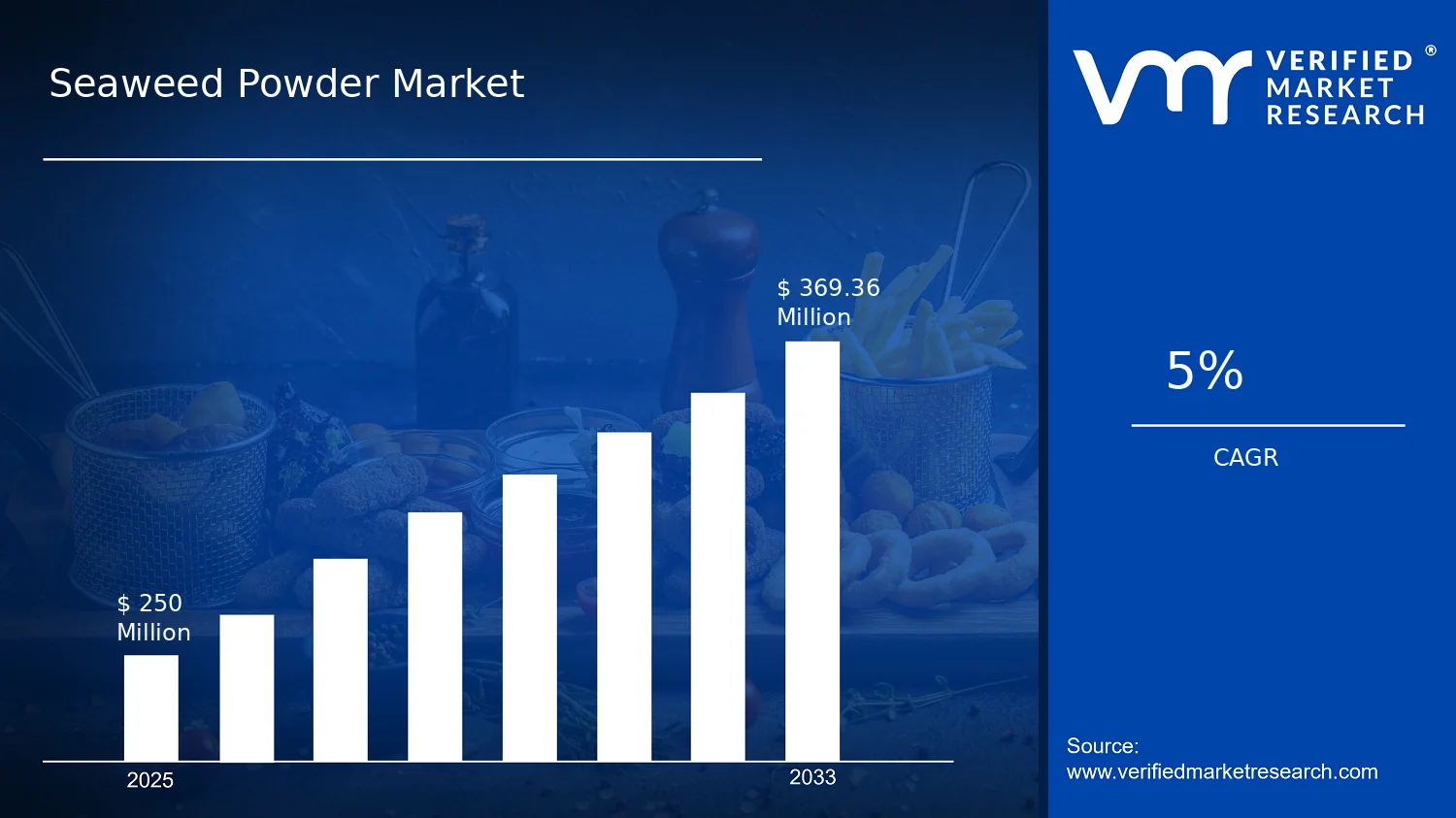
Lewes, Delaware, June 10, 2026 (GLOBE NEWSWIRE) -- The Global Seaweed Powder Market was valued at $250.00 million in 2025 and is projected to reach $369.36 million by 2033, registering a compound annual growth rate (CAGR) of 5.0% over the forecast period, according to the latest analysis published by Verified Market Research®. The Seaweed Powder Market encompasses the commercial production and exchange of dehydrated, micronized, and processed seaweed solids supplied as functional biomass and ingredient inputs for downstream formulation across food and beverage, animal feed, agriculture, and cosmetics and personal care applications.
 Download a free sample to access exclusive Insights, Data Charts, And Forecasts From Seaweed Powder Market Sample Report
Seaweed Powder Market Overview
The Seaweed Powder Market refers specifically to the production and commercial exchange of powdered seaweed products that are traded and formulated at the powder stage, delivering consistent physicochemical properties for industrial and formulation use. Key functional attributes include solubility behavior, mineral and fiber content, viscosity contribution, and film-forming or binding characteristics, which vary depending on whether the powder is derived from red, brown, or green seaweed species.
The market scope is tightly defined to exclude adjacent categories that differ materially in technology and end-use positioning. Seaweed-based liquid extracts are excluded because they are sold and qualified by extraction yield and formulation performance rather than by physical powder properties. Whole dried seaweed sheets, flakes, and fresh sea vegetables are similarly outside scope, as their value proposition and manufacturing requirements differ substantially from powders intended for uniform industrial dosing. Purified hydrocolloids such as agar and carrageenan while seaweed-derived are also excluded because buyers specify them by polymer composition and gelling behavior rather than seaweed powder characteristics.
What remains within scope is a functionally distinct ingredient powder category, characterized by repeatable dosing, application-ready stability, and documented safety attributes. These properties make seaweed powder a procurement-grade input rather than a generic marine biomass commodity, and it is this specification-driven positioning that supports the Seaweed Powder Market's steady growth trajectory from 2025 to 2033.
The market is structured along three segmentation axes: Type (Red Seaweed Powder, Brown Seaweed Powder, Green Seaweed Powder), Source (Natural, Cultivated), and Application (Food & Beverages, Animal Feed, Agriculture, Cosmetics & Personal Care). Each axis corresponds to real procurement logic, influencing buyer requirements for quality assurance, traceability, and formulation stability, and thereby shaping pricing power, adoption speed, and competitive differentiation throughout the Seaweed Powder Industry.
Download a free sample to access exclusive Insights, Data Charts, And Forecasts From Seaweed Powder Market Sample Report
Key Growth Drivers Shaping the Seaweed Powder Market
Food and Beverage Reformulation Accelerating Functional Powder Demand
One of the most immediate and measurable forces driving Seaweed Powder Market growth is the accelerating pace of reformulation activity within the global food and beverage sector. Manufacturers are under sustained pressure to replace conventional additives with clean-label alternatives that deliver reliable texture, viscosity, and emulsifying properties without compromising consumer-facing ingredient transparency. Seaweed powders particularly brown and red varieties are well positioned to fulfill this functional role, offering natural sources of minerals, gelling compounds, and viscosity-supporting agents that can be standardized through controlled processing.
As reformulation timelines shorten and product development cycles compress, the shift from bulk seaweed biomass to ready-to-dose powdered formats directly increases purchase frequency and simplifies quality management for ingredient buyers. Powdered formats enable precise dosing and more consistent batch performance, reducing formulation iteration risk and accelerating the path from trial to full production. For the Seaweed Powder Market, this dynamic converts R&D interest into durable commercial volume, particularly in categories such as beverages, sauces, baked goods, and functional nutrition products where ingredient stability and label-friendly sourcing are both purchasing criteria.
Regulatory Acceptance and Quality Frameworks Intensifying Sourcing Discipline
As ingredient scrutiny intensifies across jurisdictions, buyers in the Seaweed Powder Industry are increasingly requiring documented quality controls including contaminant testing, lot traceability systems, and standardized specifications as conditions of procurement. Compliance-driven requirements are no longer limited to regulated food applications; they are spreading into animal feed, cosmetics, and agricultural input categories, raising the baseline for supplier qualification across the Seaweed Powder Market.
This shift toward compliance-linked procurement benefits suppliers who have invested in quality management systems and processing discipline. When documentation depth and consistency track records become differentiating factors, the market rewards operators capable of meeting these requirements at scale. The net effect is an expansion of the addressable market into regulated channels including multinational food manufacturers, certified organic and natural personal care brands, and compliance-audited feed operators that previously avoided seaweed powder due to supply variability concerns. Regulatory infrastructure therefore functions not merely as a barrier to entry, but as an enabler of sustained demand at premium quality tiers.
Cultivation Scale-Up and Processing Efficiency Reducing Effective Unit Costs
Operational learning across the seaweed value chain is progressively reducing the unit cost of producing higher-grade seaweed powder. Advances in cultivation management, drying methodology, milling precision, and quality testing are improving yield recovery and defect rates, lowering the economic threshold at which premium seaweed powder can be competitively positioned across price-sensitive applications such as animal feed and agricultural inputs.
As cost barriers fall, the Seaweed Powder Market becomes accessible to a wider set of industrial buyers, including distributors and formulators who previously evaluated seaweed powder as too variable or too expensive for routine inclusion. When price stability improves alongside specification consistency, reorder cadence increases and procurement transitions from opportunistic spot purchasing toward recurring contractual arrangements a structural shift that supports more predictable demand formation and sustained market expansion throughout the forecast horizon.
Ecosystem-Level Drivers: Supply Chain Evolution and Infrastructure Maturity
Beyond individual application markets, the Seaweed Powder Industry is being reshaped by ecosystem-level changes that make core demand drivers easier to execute. Supply chains are evolving from fragmented harvesting operations toward controlled cultivation contracts and batch-based procurement frameworks, enabling consistent specifications for industrial buyers. Simultaneously, standardization of powder characteristics and quality documentation is supporting cross-application acceptance, while capacity additions in drying, milling, and analytical screening reduce the variability that previously constrained broader adoption. These infrastructure and distribution improvements accelerate reformulation readiness, strengthen regulatory confidence, and make cost advantages more durable collectively reinforcing the Seaweed Powder Market's growth trajectory through 2033.
Download a free sample to access exclusive Insights, Data Charts, And Forecasts From Seaweed Powder Market Sample Report
Market Restraints and Challenges
Regulatory and Labeling Complexity Increasing Compliance Costs
Seaweed Powder Market participants face multi-jurisdiction approval and labeling expectations that differ materially by application and geography. Food and beverage, animal feed, and cosmetics-grade seaweed powder each require distinct documentation pathways, contaminant controls, and processing records. These compliance requirements raise operational budgets, extend commercialization timelines, and reduce the number of new product launches achievable within a given fiscal cycle. For smaller or newer market entrants, the compliance burden can be prohibitive, limiting the supplier pool and slowing overall Seaweed Powder Market adoption velocity.
Input Cost Volatility from Natural Sourcing Disrupting Procurement Planning
Natural sourcing performance varies with harvest conditions, seasonal cycles, and regional environmental factors, creating fluctuations in yield and compositional consistency that directly affect downstream procurement stability. When price and quality variability occur simultaneously, manufacturers face a difficult set of trade-offs: absorbing cost increases, reducing seaweed powder inclusion rates, or renegotiating supply terms under unfavorable conditions. Within the Seaweed Powder Industry, this instability pressures margins and discourages long-term purchase commitments, particularly in large-volume applications such as animal feed and agriculture where contract stability is a prerequisite for formula standardization.
Operational Scaling Constraints in Processing and Standardization Capacity
Seaweed powder supply chains require reliable and capital-intensive processing steps including cleaning, drying, milling, quality control, and batch documentation to maintain product safety and functional performance. Scaling these stages demands investment, trained labor, and enforceable standards that frequently lag behind demand growth. As throughput constraints emerge, lead times lengthen and availability becomes inconsistent across grades. For the Seaweed Powder Market, production bottlenecks restrict the ability to meet new buyer requirements at scale, slowing market development even when baseline demand remains steady. Processing capacity therefore functions as a structural ceiling on short-term growth in specific segments and geographies.
Download a free sample to access exclusive Insights, Data Charts, And Forecasts From Seaweed Powder Market Sample Report
Emerging Opportunities in the Seaweed Powder Industry
Specialized Formulation Demand Driving Grade Differentiation
As formulation sophistication increases across food and beverage manufacturers, demand is rising for seaweed powders with predictable thickening, stabilizing, and flavor-supporting performance at defined inclusion levels. The opportunity for Seaweed Powder Market participants lies in converting R&D trial interest into long-term sourcing by offering application-specific grades with tighter specifications, comprehensive certificates of analysis, and consistent batch-to-batch documentation. Market gaps currently exist around variability in functional performance and incomplete specification documentation, which slow approval cycles and limit supplier penetration among contract manufacturers and multinational food producers.
Brown Seaweed Powder Adoption Scaling in Animal Feed
Animal feed represents a compelling expansion channel for the Seaweed Powder Market as sustainability-driven ingredient screening tightens and feed manufacturers seek dependable inputs that support nutrient utilization strategies. The opportunity pathway runs from limited pilot inclusion to scalable procurement, driven by the availability of cultivated brown seaweed powder with consistent mineral profiles and reliable processing compatibility. Suppliers that can align source traceability with feed-formulation compatibility packaging and reduce technical friction in validation timelines are positioned to convert initial trials into recurring contract supply, unlocking a high-volume, repeat-order demand channel with favorable logistics economics.
Cultivated Green and Red Powders Unlocking Cosmetics and Personal Care
Cosmetics and personal care represents a structurally underserved opportunity within the Seaweed Powder Industry, with growth constrained primarily by concerns around raw material consistency, microbiological control, and the documentation required for brand governance and regulatory compliance. The opening is emerging now as reformulation programs increasingly favor ingredients that can be audited and maintained stable across production runs. Suppliers that develop cultivated-focused production lots, publish clear quality attributes, and build ingredient dossiers aligned to cosmetic testing requirements can unlock broader commercialization and expand distribution through professional formulation channels a pathway with strong margin potential relative to commodity applications.
Technology and Innovation Trends in the Seaweed Powder Market
Process Control for Functional Consistency
A defining technology trend reshaping the Seaweed Powder Market is the shift from generic ingredient availability toward specification-oriented production, where functional properties are actively managed at the manufacturing stage. Producers are tightening process parameters that govern powder functionality including treatment conditions, drying temperatures, and milling configurations to preserve target constituents and stabilize powder characteristics from lot to lot. In practical terms, this reduces formulation trial-and-error for food and beverage and cosmetics buyers, while enabling animal feed and agriculture formulators to specify performance outcomes with fewer revisions to dosing and mixing protocols. Type differentiation is intensifying as a result, with red, brown, and green seaweed powders increasingly treated as distinct functional inputs with separate processing requirements and application mappings.
Gentler Drying and Particle-Sizing Approaches Preserving Performance
Powder performance is frequently constrained by how aggressively biomass is dried and milled, which can alter solubility, rehydration behavior, and dispersibility that downstream applications depend on. Innovation in this area focuses on developing drying techniques and milling routes that balance throughput with functional preservation. As these methods scale, manufacturers can supply larger volumes while maintaining predictable behavior in mixing-heavy environments such as commercial beverage processing and bulk feed formulation. For the Seaweed Powder Market, this represents a critical enabler of broader adoption, since reliability in functional performance carries more purchasing weight than marginal unit cost differences for most industrial buyers.
Expanded Quality Assurance and Traceability Systems
As demand grows across regulated applications, buyers require evidence that powder batches meet safety and specification expectations tied to origin. Technological evolution in quality assurance is strengthening traceability and batch-level testing workflows, enabling producers to link production records to measured outcomes for both natural and cultivated sourcing streams. Expanded QA capability reduces procurement friction, supports repeat ordering based on documented consistency, and improves feasibility for regulatory-sensitive formulations in food, feed, and personal care. In competitive terms, operational maturity in compliance and documentation is increasingly acting as a market access gate rather than a cost line rewarding suppliers that invest systematically in quality infrastructure within the Seaweed Powder Industry.
Application-Specific Product Development and Multi-Category Positioning
Innovation investment is also moving toward derivative formats and blend-ready variants designed for specific end-use environments. Examples include stabilized powders optimized for foam and emulsification in food and beverage applications, palatability-optimized formulations for animal feed premix systems, and moisture-compatible versions suited to agronomic spray programs. This product development trajectory reflects a broader competitive shift in the Seaweed Powder Market: buyers increasingly evaluate functional performance outcomes rather than simply seaweed content, and suppliers that can demonstrate stable, application-calibrated behavior across grades and lots are converting trials into long-term supply relationships more effectively than commodity-positioned alternatives.
Download a free sample to access exclusive Insights, Data Charts, And Forecasts From Seaweed Powder Market Sample Report
Industry Use Cases and End-User Application Landscape
Food and Beverages: Formulation Integration and Clean-Label Functionality
In food processing, seaweed powder is incorporated into recipes where hydrocolloid behavior supports texture, viscosity, and suspension stability. Ingredient teams select powder type and grade based on how it hydrates under the plant's specific mixing regime, including order of addition, shear conditions, and residence time during batch processing. When powder batches perform consistently during hydration, production managers can maintain standard texture targets without extended rework, directly supporting line efficiency and recipe repeatability. This use case drives durable procurement demand within the Seaweed Powder Market because ingredient qualification tends to lock in suppliers once a formulation moves into full production and quality gates are consistently met. Red seaweed powder is particularly relevant where gel-forming properties are critical, while brown seaweed powder serves higher-volume functional roles tied to viscosity, mineral content, and stabilizing behavior.
Animal Feed: Consistent Micronutrient Delivery and Process Compatibility
Animal feed operations integrate seaweed powder as part of dry ingredient premixes or blends that feed mills can scale through automated batching and mixing. The key operational requirement is that the powder behaves predictably in bulk handling and blending, enabling inclusion rates to be managed within established formulation tolerances. Feed technologists evaluate how the ingredient supports targeted nutritional goals while remaining compatible with pelletization or mixing protocols used by the mill. When the powder maintains uniform dispersion and stable performance across batches, formulators reduce variability at the farm intake stage a critical outcome for large livestock and aquaculture operators. This use case sustains Seaweed Powder Market demand because feed producers favor inputs that can be standardized for routine manufacturing rather than those requiring frequent process recalibration.
Agriculture: Routine Application Workflows for Agronomic Programs
Agricultural use is structured around operational timing and repeatable application routines, typically through dilution and spray or drench methods used in both greenhouse and field contexts. Growers and agronomic service teams adopt seaweed powder where preparation steps fit existing equipment and where mixing does not create clogs or inconsistent coverage. The practical requirement for this application is not just product performance, but application reliability under real field conditions including variable water quality, short operational windows, and seasonal scheduling constraints. Repeat purchasing in the Seaweed Powder Market's agriculture segment depends on how consistently the powder integrates into existing application workflows and how reliably outcomes support continued use within established farm programs across seasons.
Cosmetics and Personal Care: Formulation Reproducibility and Sensory Performance
In cosmetics and personal care, seaweed powder input is evaluated against how it behaves in emulsions, gels, and cleansing systems, influencing both production efficiency and shelf-life management. Formulators require reproducible sensory performance including texture, color consistency, and compatibility with active ingredients and place significant weight on ingredient documentation, lot stability, and regulatory compliance. Within the Seaweed Powder Industry, this application tends to place more conservative procurement timelines on new supplier relationships, but once qualification is achieved, it can generate sustained demand through developer kits, professional formulations, and long-term supply agreements. Cultivated sourcing is gaining traction in this segment specifically because it supports tighter specification control and cleaner ingredient dossiers that satisfy brand governance requirements.
Download a free sample to access exclusive Insights, Data Charts, And Forecasts From Seaweed Powder Market Sample Report
Regional Outlook: Seaweed Powder Market by Geography
Asia Pacific: High-Growth Expansion Driven by Cultivation and Diversified End-Uses
Asia Pacific leads the Global Seaweed Powder Market with approximately 42% market share, driven by extensive cultivation infrastructure, large-scale food and agricultural consumption, and competitive processing economics. The region benefits from established seaweed farming operations that can supply consistent cultivated biomass across red, brown, and green seaweed types, reducing the sourcing variability that constrains adoption in less integrated supply chains. Japan and Australia tend to progress faster on higher-specification powder applications for food-grade and personal care use, while India and parts of Southeast Asia scale demand through broader population consumption, expanding agro-industrial inputs, and cost-sensitive procurement models.
The region's manufacturing scale supports faster industrial adoption, while large population bases sustain strong baseline demand for food and beverages and intensive livestock and aquaculture systems generate concentrated pull for animal feed applications. Infrastructure development including improving port facilities, cold-chain logistics, and distribution networks is reducing friction in moving seaweed powders to industrial customers. However, uneven regulatory enforcement across countries creates a fragmented market, with compliant export-oriented supply channels operating alongside domestic-oriented networks that face different documentation requirements. Government-led industrial initiatives and aquaculture development programs can create step-change growth phases, contributing to the region's position as the dominant geography in the Seaweed Powder Market Forecast through 2033.
North America: Innovation-Led Demand and Specification-Driven Procurement
North America's Seaweed Powder Market is characterized by innovation-driven demand concentrated among specialty food formulators, nutraceutical developers, and sustainability-focused agricultural input providers. Procurement practices emphasize traceable raw materials, predictable particle characteristics, and documented functional performance requirements that favor cultivated sourcing and processing discipline over commodity-priced natural inputs. Compliance expectations for food, personal care, and feed-adjacent applications encourage suppliers to invest in testing workflows and consistent batch documentation.
Product development cycles and procurement approvals tend to move more deliberately in North America than in emerging regions, reflecting the depth of documentation requirements and technical qualification processes. However, once qualification is achieved, these relationships are highly durable, with strong reorder rates tied to formulation lock-in. Investment tends to concentrate where formulations can justify cost premiums through differentiated performance, such as binding and stabilizing functions in food and beverage or conditioning benefits in cosmetics a pattern that aligns Seaweed Powder Market growth with technical commercial wins rather than broad volume adoption.
Europe: Regulation-Led Discipline and Premium Quality Expectations
Europe's seaweed powder demand is shaped by EU-aligned regulatory harmonization, tightly integrated cross-border ingredient procurement, and premium quality expectations across food, feed, and cosmetics applications. The region's compliance environment drives manufacturers to maintain stable powder characteristics, standardized micronutrient and contaminant profiles, and robust chain-of-custody processes to satisfy audit requirements that are embedded as operational prerequisites rather than optional differentiators.
Sustainability and environmental compliance pressure adds an additional dimension to sourcing evaluation in Europe, influencing how natural versus cultivated supply origins are assessed. Where traceability, resource stewardship, and ecological impact mitigation are scrutinized, cultivated sourcing gains a structural advantage. The region's cross-border logistics integration favors suppliers capable of predictable lead times, consistent packaging formats, and uniform batch documentation factors that push greater emphasis on standardized processing and QA maturity across red, brown, and green seaweed powder grades within the Seaweed Powder Market.
Latin America: Emerging Adoption with Macro-Condition Dependencies
Latin America presents an emerging and gradually expanding market for Seaweed Powder Market applications, with demand building unevenly across Brazil, Mexico, and Argentina. Growth tracks broader economic cycles, with currency volatility capable of materially altering the landed cost of imported inputs and finished powders, creating demand instability in cost-sensitive applications such as food and beverage and cosmetics and personal care. Reliance on imports and external supply chains introduces lead-time risk and procurement planning challenges that can slow formula qualification and extend adoption timelines.
Industrial development is uneven across the region, with advanced processing capabilities concentrated in a subset of markets and infrastructure limitations including transport and warehousing constraints affecting the ability to maintain consistent inventory. Regulatory variability and policy inconsistency across national frameworks create a patchwork commercialization pathway, slowing the Seaweed Powder Market's progression in specific application categories even where technical demand is present. Foreign investment in sourcing partnerships and processing tends to progress incrementally, beginning with pilot buyers before scaling into broader procurement programs, producing adoption curves that advance through defined phases rather than uniformly.
Middle East and Africa: Selective Development with Policy-Led Acceleration
The Middle East and Africa represents a selectively developing segment of the Global Seaweed Powder Market, with demand formation anchored in Gulf economies where food processing modernization, nutraceutical interest, and government-backed industrial diversification programs create early commercial pull. Government-backed diversification initiatives in Gulf markets prioritizing food security and technically verified inputs can translate into faster qualification of seaweed powders for food and beverage, cosmetics, and agricultural applications, particularly where procurement is centralized and specifications are enforced.
Across Africa, infrastructure variation and import dependence shape availability and consistency of seaweed powder supply, with demand concentrated in cities and institutional settings including food processors, regulated agricultural programs, and certified cosmetic manufacturers. Regulatory inconsistency across national frameworks creates differing approval timelines for specific seaweed powder types and applications, explaining why Seaweed Powder Market expansion in this region proceeds in clusters around procurement-driven centers rather than progressing uniformly. Port handling reliability, shipment continuity, and cross-border documentation readiness are key structural constraints that will determine the pace of market development through 2033.
Download a free sample to access exclusive Insights, Data Charts, And Forecasts From Seaweed Powder Market Sample Report
Competitive Landscape: Key Players in the Seaweed Powder Industry
The Seaweed Powder Market competitive landscape in 2025 is characterized by a moderately fragmented structure, with companies competing through supply capability, product standardization, processing discipline, and route-to-market fit. Competitive intensity is shaped less by participant headcount than by the ability to secure consistent seaweed raw material, translate it into application-ready powders with documented traceability, and sustain functional performance across grades and lots. Strategic positioning tends to split between scale-oriented processors with broad procurement networks and application-focused specialists concentrated in specific seaweed types or cultivation-linked sourcing.
Cargill Incorporated
Cargill Incorporated participates in the Seaweed Powder Market primarily as an integrator whose influence derives from procurement sophistication, scale, and a disciplined approach to quality systems. Its role is most visible through the ability to translate seaweed inputs into standardized ingredient formats that downstream customers can specify and source with reduced operational risk. Differentiation centers on process control, documentation rigor, and consistency across batches factors that carry decisive weight in food and beverage and cosmetics applications where sensory performance and contaminant compliance govern adoption. Cargill's positioning raises the competitive baseline for specification discipline across the industry, pressuring the market on batch traceability and performance repeatability rather than simply on price.
Acadian Seaplants Limited
Acadian Seaplants Limited operates as a specialist with strong emphasis on sea-based sourcing and functional ingredient performance, orienting its role around converting seaweed biomass into application-relevant inputs where powder functionality and usability are the primary purchasing criteria. Differentiation comes from controlled sourcing practices, consistent processing, and the ability to meet technical requirements related to bioactive content and powder behavior in formulations. This specialization sharpens the competitive benchmark for agriculture and animal feed use cases, where dosing, mixing performance, and stability over storage are decisive. By supplying predictable grades that reduce formulation iteration burden, Acadian contributes to a broader market shift from generic seaweed powder purchasing toward structured grade selection tied to functional outcomes.
CP Kelco
CP Kelco occupies a bridging position between functional ingredient manufacturing and end-application requirements, relevant for seaweed powder used as a texture, stabilizing, or functional component in food and personal care formulations. Differentiation is expressed through process capability and the ability to deliver powders that behave consistently under formulation constraints, supporting compliance and performance outcomes across production environments. Within the Seaweed Powder Market, CP Kelco's positioning raises the importance of functional reproducibility including dispersion behavior and interaction with other formulation ingredients pressuring competitors to demonstrate specification reliability and formulation compatibility rather than competing solely on commodity pricing.
Gelymar S.A.
Gelymar S.A. is positioned as an operational and supply-focused participant emphasizing seaweed processing expertise and product consistency. Its role centers on converting seaweed biomass into powders that satisfy buyer requirements across multiple applications, with differentiation expressed through supply readiness and the ability to meet repeatable quality parameters for powder usability. When suppliers like Gelymar maintain stable output, buyers are more willing to scale trials into regular procurement particularly in animal feed and agriculture where adoption depends on low operational disruption. This availability-focused positioning influences market pricing dynamics for standardized grades and accelerates commercialization in regions that require reliable sourcing and predictable lead times.
Qingdao Bright Moon Seaweed Group Co. Ltd.
Qingdao Bright Moon Seaweed Group Co. Ltd. represents a regional scale and execution model with emphasis on throughput and manufacturing capability, with influence particularly relevant in regions where cultivated supply and cost-effective production are important for customer expansion. Differentiation tends to be shaped by the ability to manage raw material sourcing logistics and support consistent powder output across seaweed types, enabling buyers to access multiple grades. This role increases competitive pressure on pricing and supply availability, supporting diversification of customer procurement strategies and reinforcing a market trend toward more standardized grade structures and clearer specification labeling across type and source categories.
Additional Market Participants
Beyond the five primary players, the Seaweed Powder Industry includes a competitive cohort of application-specialist and regionally focused participants including Seasol International Pty Ltd, Algaia S.A., Ocean Harvest Technology, Mara Seaweed, and Maine Coast Sea Vegetables. These companies collectively increase competitive intensity by expanding the range of available grades, particularly for agriculture and cosmetics applications where formulation flexibility and traceability influence adoption. Several function as application translators, winning customer access through formulation guidance rather than commodity supply, while others emphasize niche sourcing credentials or cultivation-aligned supply chains. Looking toward 2033, the Seaweed Powder Market is expected to see selective consolidation among participants that cannot meet evolving compliance and QA expectations, alongside ongoing diversification for companies differentiating through grade specialization by seaweed type and application-specific performance.
Download a free sample to access exclusive Insights, Data Charts, And Forecasts From Seaweed Powder Market Sample Report
Seaweed Powder Market Segmentation
By Type
- Red Seaweed Powder Finds durable adoption where gel-forming and targeted functionality matter, supporting steady demand in food formulation, cosmetics, and personal care workflows requiring consistent functional profiles.
- Brown Seaweed Powder Supports higher-volume functional uses due to its composition profile, including mineral-related functionality and formulation versatility, making it a frequent candidate in food processing, industrial formulations, and animal feed applications.
- Green Seaweed Powder Supports niche positioning in cleaner-label and formulation-specific applications, with adoption driven by quality documentation and controlled sourcing in cosmetics and specialty food preparations.
By Source
- Natural Aligned with premium quality requirements and selective commercialization; higher variability from harvest conditions requires stronger testing and documentation discipline to meet procurement specifications.
- Cultivated The dominant segment, offering better predictability for scaled contracts, supporting sustained procurement in food and beverage and cosmetics and personal care through improved supply planning, quality control, and batch repeatability.
By Application
- Food & Beverages The primary volume and commercialization driver, where seaweed powders support texture, viscosity, and clean-label positioning across diverse product categories including beverages, sauces, and functional nutrition.
- Animal Feed Growing segment driven by performance-oriented ingredient screening, leveraging seaweed powder's compatibility with existing premix and processing workflows and its contribution to nutritional strategies.
- Agriculture Expanding as growers adopt seaweed powder in soil and plant support programs compatible with sustainability-oriented procurement and modern agronomic application schedules.
- Cosmetics & Personal Care Value-driven segment where ingredient narrative, sensory performance, and formulation reproducibility support resilient demand independent of broader category fluctuations.
By Geography
- Asia Pacific Dominant region with approximately 42% market share; high cultivation penetration, large consumption base, and diversified end-use demand across food, agriculture, and animal feed.
- North America Innovation-led, specification-driven demand concentrated among specialty formulators and sustainability-focused input providers, with durable procurement relationships post-qualification.
- Europe Regulation-led purchasing discipline and premium quality expectations; cross-border logistics integration favors suppliers with consistent documentation and standardized processing.
- Latin America Emerging, macro-dependent adoption across Brazil, Mexico, and Argentina, progressing through defined phases tied to industrial development and import supply chain maturity.
- Middle East & Africa Selectively developing region anchored in Gulf economies, with policy-led industrial diversification creating pockets of accelerated adoption in food processing and agricultural modernization programs.
Download a free sample to access exclusive Insights, Data Charts, And Forecasts From Seaweed Powder Market Sample Report
Strategic Outlook: Seaweed Powder Market Through 2033
The Seaweed Powder Market is entering a phase of sustained, application-driven expansion rather than cyclical or speculative growth. From the base of $250.00 million in 2025, the trajectory toward $369.36 million by 2033 reflects incremental penetration across end markets as suppliers close the gap between commodity sourcing and specification-grade ingredient delivery. The Seaweed Powder Market Forecast is anchored in structural forces that are expected to compound rather than plateau: reformulation activity in food and beverage is a multi-year cycle that continuously generates new qualified applications; regulatory tightening sustains competitive differentiation around quality management; and the shift from natural to cultivated supply increasingly enables the procurement planning stability that large industrial buyers require.
Competitive dynamics within the Seaweed Powder Industry are expected to evolve toward tighter quality assurance requirements, more differentiated grade specifications by application, and selective consolidation among participants unable to sustain evolving compliance and performance standards. Simultaneously, innovation at the processing level in drying, milling, and functional preservation will create new opportunities to develop application-specific portfolio positions that command premium pricing and longer contract durations. The interaction between type specialization (red, brown, green), source discipline (natural versus cultivated), and application qualification (food, feed, agriculture, cosmetics) will remain the central framework governing where growth concentrates and where competitive moats are most durable through the forecast period.
For investors, the Seaweed Powder Market offers an opportunity set structured around controllable supply chains, technology-linked extraction pathways, and ingredient performance innovation. Recent capital allocation patterns including consolidation actions targeting cultivated sourcing capacity and clean-label ingredient development reflect market confidence in near-term commercialization. Stakeholders who align investment in processing capability, traceability systems, and application-specific product development with the operational realities of each segment are best positioned to translate the Seaweed Powder Market's forecast growth into sustainable commercial execution.
Related Reports
Global Seaweed Farming Market Size By Seaweed Type (Brown Seaweed, Red Seaweed, Green Seaweed), By Farming Technique (Off-shore Cultivation, On-shore Cultivation), By Application (Food & Beverages, Pharmaceuticals & Nutraceuticals, Cosmetics & Personal Care, Agriculture & Animal Feed), By Geographic Scope and Forecast
Global Seaweed Salts Market Size By Type (Food Grade Seaweed Salts, Cosmetic Grade Seaweed Salts, Industrial Grade Seaweed Salts), By Application (Food Processing, Personal Care and Cosmetics, Agriculture, Pharmaceuticals, Animal Feed), By Geographic Scope And Forecast
Global Seaweed Food Hydrocolloids Market Size By Type (Carrageenan, Alginates, Agar-Agar), By Source (Red Seaweed, Brown Seaweed, Green Seaweed), By Application (Dairy & Frozen Products, Meat & Poultry Products, Bakery & Confectionery), By Geographic Scope and Forecast
Global Agricultural Biological Growth Stimulant Market Size By Type (Humic Substances, Seaweed Extracts, Microbial Stimulants, Amino Acids and Protein Hydrolysates), By Application (Cereals and Grains, Fruits and Vegetables, Oilseeds and Pulses, Turf and Ornamentals), By Geographic Scope And Forecast
5 Leading Nonwoven Fabrics Brands: Transformation at its best
Visualize Seaweed Powder Market using Verified Market Intelligence -:
Verified Market Intelligence is our BI Enabled Platform for narrative storytelling in this market. VMI offers in-depth forecasted trends and accurate Insights on over 20,000+ emerging & niche markets, helping you make critical revenue-impacting decisions for a brilliant future.
VMI provides a holistic overview and global competitive landscape with respect to Region, Country, Segment, and Key players of your market. Present your Market Report & findings with an inbuilt presentation feature saving over 70% of your time and resources for Investor, Sales & Marketing, R&D, and Product Development pitches. VMI enables data delivery In Excel and Interactive PDF formats with over 15+ Key Market Indicators for your market.
About Us
Verified Market Research® stands at the forefront as a global leader in Research and Consulting, offering unparalleled analytical research solutions that empower organizations with the insights needed for critical business decisions. Celebrating 10+ years of service, VMR has been instrumental in providing founders and companies with precise, up-to-date research data.
With a team of 500+ Analysts and subject matter experts, VMR leverages internationally recognized research methodologies for data collection and analyses, covering over 15,000 high impact and niche markets. This robust team ensures data integrity and offers insights that are both informative and actionable, tailored to the strategic needs of businesses across various industries.
VMR's domain expertise is recognized across 14 key industries, including Semiconductor & Electronics, Healthcare & Pharmaceuticals, Energy, Technology, Automobiles, Defense, Mining, Manufacturing, Retail, and Agriculture & Food. In-depth market analysis cover over 52 countries, with advanced data collection methods and sophisticated research techniques being utilized. This approach allows for actionable insights to be furnished by seasoned analysts, equipping clients with the essential knowledge necessary for critical revenue decisions across these varied and vital industries.
Verified Market Research® is also a member of ESOMAR, an organization renowned for setting the benchmark in ethical and professional standards in market research. This affiliation highlights VMR's dedication to conducting research with integrity and reliability, ensuring that the insights offered are not only valuable but also ethically sourced and respected worldwide.
Follow Us On: LinkedIn | Twitter | Threads | Instagram | Facebook

Mr. Edwyne Fernandes

Verified Market Research®

US: +1 (650)-781-4080

US Toll Free: +1 (800)-782-1768

Email: sales@verifiedmarketresearch.com

Web: https://www.verifiedmarketresearch.com/

SOURCE – Verified Market Research®

Legal Disclaimer:
EIN Presswire provides this news content "as is" without warranty of any kind. We do not accept any responsibility or liability for the accuracy, content, images, videos, licenses, completeness, legality, or reliability of the information contained in this article. If you have any complaints or copyright issues related to this article, kindly contact the author above.
