

Global Computer Vision in Healthcare Market Trends and Forecast: Industry to Hit USD 54.28 Billion by 2034
Computer Vision in Healthcare Market
The computer vision in healthcare market is led by key companies such as IBM, Siemens Healthineers, GE HealthCare, Philips, Microsoft and more.
PUNE, MAHARASHTRA, INDIA, February 8, 2026 /EINPresswire.com/ -- Computer vision in healthcare enables real-time analysis of medical images including X-rays, CT scans, and MRIs. It facilitates improved treatment accuracy, predictive healthcare, and personalized patient care. Hospitals and diagnostic centers are increasingly adopting these systems to enhance operational efficiency and deliver high-quality patient outcomes. The market's growth is fueled by the rising prevalence of chronic diseases and a global emphasis on precision medicine. The computer vision in healthcare market is projected to witness exponential growth in the coming years, driven by the rising burden of diseases and increasing global demand for precise diagnostics and patient management through computer vision in healthcare.The global computer vision in healthcare market was valued at USD 5.57 billion in 2025 and is projected to reach USD 54.28 billion by 2034, growing at a remarkable CAGR of 29.17% during the forecast period. This growth is primarily driven by increasing demand for accurate diagnostics, enhanced patient monitoring, and efficient hospital operations leveraging computer vision technologies.
Get a Free Sample Research Report: https://www.fortunebusinessinsights.com/enquiry/request-sample-pdf/computer-vision-in-healthcare-market-114851
Key Market Drivers
The growing trend toward surgical automation and image-guided procedures is a significant driver. Modern operating rooms demand higher precision due to complex surgical cases and minimally invasive procedures. Computer vision systems provide real-time visualization, anatomical mapping, and 3D reconstruction, facilitating informed decision-making during surgery.
For example, in March 2025, Artisight partnered with KARL STORZ and NVIDIA to integrate AI-powered solutions into smart operating rooms. This collaboration introduced Pathway.AI, an AI platform that automates perioperative tasks using computer vision, significantly enhancing surgical workflow efficiency.
Market Restraints
Despite the potential, the market faces adoption challenges due to high costs and operational complexity. Advanced surgical and image-guided systems require specialized cameras, sensors, and embedded processors, making them expensive to implement. Additionally, hospitals must provide extensive training and integrate these systems with existing IT infrastructure, increasing operational burden.
For instance, the da Vinci XI robotic-assisted surgical system in the U.K. costs USD 2.16 million, limiting adoption among smaller hospitals.
Opportunities in AI Integration
Technological advancements and AI integration in computer vision systems present significant growth opportunities. AI-powered models analyze complex medical images, detect subtle patterns, and support clinical decisions with enhanced precision. Companies are increasingly forming strategic partnerships to leverage AI and digital transformation for next-generation healthcare solutions.
In November 2024, Lumenalta partnered with Roboflow to enhance AI data management and computer vision model development, highlighting the industry’s focus on innovation through collaboration.
Market Trends
A major trend in the market is integrating AI-enabled computer vision into clinician workflows. Radiologists and pathologists benefit from AI systems that automatically prioritize urgent cases, quantify disease progression, and provide explainable outputs. Hospitals are also seeking solutions that seamlessly integrate with PACS, LIS, and reporting systems, enhancing efficiency and accuracy.
For example, GE HealthCare and NVIDIA collaborated in March 2025 to innovate autonomous imaging solutions, beginning with X-ray and ultrasound applications, demonstrating the increasing adoption of AI-driven computer vision in clinical workflows.
Market Challenges
Data security and privacy remain key challenges, as medical images often contain sensitive patient information. The use of cloud platforms and AI tools can increase the risk of HIPAA or GDPR non-compliance, slowing adoption. Reports indicate healthcare workers may inadvertently expose protected health information via generative AI tools or unsecured cloud storage, impacting consumer trust.
Segmentation Analysis
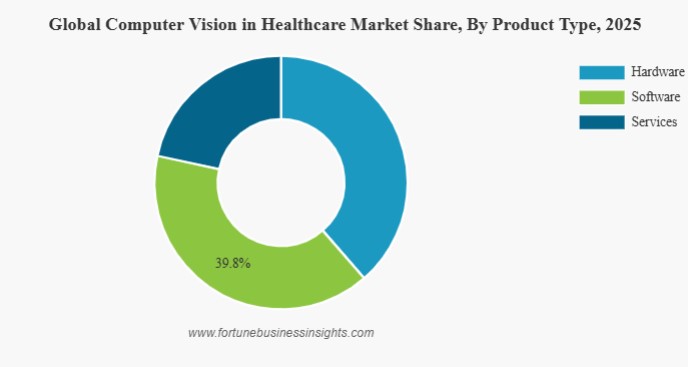
The market is segmented by product type, application, and end user.
By Product Type (Hardware {Smart Cameras, Sensors, Memory Devices, and Others}, Software, and Services)
By Application (Medical Imaging, Patient Monitoring, Surgical Assistance, Diagnostic Assistance, and Others)
By End User (Hospitals & Specialty Clinics, Diagnostic Centers, and Others)
Speak to Analyst: https://www.fortunebusinessinsights.com/enquiry/request-sample-pdf/computer-vision-in-healthcare-market-114851
Key Players in the Market
IBM (Germany)
Siemens Healthineers AG (U.S.)
GE HealthCare (U.S.)
Koninklijke Philips N.V. (The Netherlands)
Stryker (U.S.)
Fujitsu (Japan)
Google LLC (U.S.)
Tempus AI, Inc. (U.S.)
NVIDIA Corporation (U.S.)
Microsoft (U.S.)
These companies focus on integrating advanced technologies and strengthening product offerings through strategic collaborations, which further solidifies their position in the global market.
Recent Industry Developments
October 2025: Arteris, Inc. collaborated with Axelera AI and licensed FlexNoC 5 interconnect IP to develop the Europa platform, a high-performance solution supporting computer vision and generative AI applications.
January 2025: Blaize Holdings partnered with alwaysAI to integrate advanced computer vision technology with Blaize’s edge devices, enabling remote deployments and expanding global accessibility.
Regional Insights
North America leads the computer vision in healthcare market due to advanced healthcare infrastructure and high adoption of AI-based solutions. Europe and Asia Pacific are witnessing growing adoption, driven by increasing investments in healthcare technology and expanding hospital networks. Emerging markets are also expected to contribute significantly to the overall market growth during the forecast period.
Future Market Scope
The computer vision in healthcare market is poised for rapid expansion as AI integration, technological advancements, and increasing demand for precise diagnostics continue to drive growth. Strategic partnerships, collaborations, and investments in AI-enabled systems will further strengthen the market landscape, providing opportunities for new entrants and existing players alike.
Ashwin Arora
Fortune Business Insights™ Pvt. Ltd.
+1 833-909-2966
sales@fortunebusinessinsights.com
Legal Disclaimer:
EIN Presswire provides this news content "as is" without warranty of any kind. We do not accept any responsibility or liability for the accuracy, content, images, videos, licenses, completeness, legality, or reliability of the information contained in this article. If you have any complaints or copyright issues related to this article, kindly contact the author above.
