

Earth Observation Market Set to Reach USD 14.55 Billion by 2034, As Satellite Data Demand Rises
Earth Observation Market size
Industry Valued at USD 7.04 billion in 2025, the market is expanding steadily as governments and businesses increase reliance on satellite-based insights.
Growing demand for environmental monitoring, defense intelligence, and infrastructure planning, along with strong space programs in North America, is driving global market growth.”
PUNE, MAHARASHTRA, INDIA, February 8, 2026 /EINPresswire.com/ -- The global earth observation market is witnessing strong expansion as governments and enterprises increasingly rely on satellite data for environmental monitoring, defense intelligence, and infrastructure planning. The market was valued at USD 7.04 billion in 2025 and is projected to grow from USD 7.68 billion in 2026 to USD 14.55 billion by 2034, registering a CAGR of 8.31% during the forecast period. North America dominated the global market in 2025, accounting for a 34.97% share, supported by strong government space programs and advanced geospatial analytics infrastructure.— Fortune Business Insights
Earth observation (EO) refers to the collection and analysis of data about the planet using satellites, aircraft, drones, and ground-based sensors. The market includes imagery data, remote sensing platforms, and analytics services that transform raw observations into actionable insights. EO technologies span optical, radar, hyperspectral, and thermal imaging systems, providing high-resolution, real-time visibility of environmental and human activity.
The technology supports a wide range of applications, including deforestation tracking, crop monitoring, natural disaster management, defense intelligence, and urban planning. In recent years, demand has increased due to the rise of small satellite constellations, synthetic aperture radar (SAR), cloud-based analytics, and climate-focused initiatives.
Get Free Sample PDF Here: https://www.fortunebusinessinsights.com/enquiry/request-sample-pdf/earth-observation-market-114486
Market Drivers
Growing Role of Satellite Data Across Industries
The increasing reliance on satellite-based data for environmental, economic, and security applications is a major driver of market growth. Governments and private organizations are investing heavily in EO capabilities to monitor climate patterns, track urban expansion, manage natural resources, and support defense operations.
Market Restraints
High Costs and Data Complexity
Despite strong growth, several challenges continue to limit broader adoption. Launching and maintaining satellite constellations requires substantial capital investment, creating high entry barriers for new players. Optical imaging systems are also affected by weather conditions and cloud cover, reducing data consistency.
Market Opportunities
Digital Transformation and Data Integration
The next growth phase for the EO market lies in data integration and advanced analytics. As industries adopt digital transformation strategies, EO data is increasingly combined with AI, IoT sensors, and digital twin platforms to generate predictive insights.
These capabilities are unlocking new applications in precision agriculture, carbon monitoring, infrastructure management, and climate adaptation. The growing emphasis on sustainability and ESG transparency is also driving demand for satellite-based emissions tracking and ecosystem monitoring.
Market Trends
Shift Toward Real-Time, AI-Driven Observation
The EO industry is transitioning from periodic imaging to continuous, AI-driven monitoring of the planet. AI-powered analytics are enabling faster interpretation of satellite imagery across agriculture, defense, and environmental applications.
Multi-sensor data fusion—combining optical, radar, thermal, and hyperspectral inputs—is becoming standard practice to improve accuracy and insight depth. Cloud-based EO marketplaces are also democratizing access to satellite intelligence, allowing smaller organizations to use geospatial data.
Market Challenges
Data Volume and Technical Complexity
One of the biggest challenges facing the industry is the massive volume of data generated by thousands of satellites. Processing and storing these datasets requires advanced cloud infrastructure and AI-driven analytics.
Many organizations still struggle to convert raw imagery into actionable insights due to limited technical expertise and the lack of standardized analytical frameworks. Cybersecurity threats, orbital congestion, and the risk of space debris collisions also pose operational risks.
Segmentation Analysis
By Orbit
The market is segmented into LEO, MEO, GEO, and others.
The LEO segment held the largest share at 42.83% in 2026, driven by the deployment of small-satellite constellations for high-frequency imaging.
The GEO segment is expected to grow at the highest CAGR of 9.06% during the forecast period.
By Solution
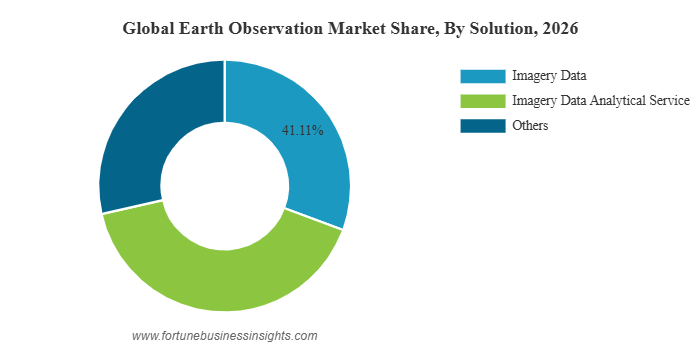
Segments include imagery data, imagery data analytical services, and others.
The imagery data analytical services segment led with a 41.11% share in 2026, as organizations increasingly demand AI-driven insights rather than raw images.
By Image Resolution
The market is divided into very high, high, medium, and low resolution.
The very high-resolution segment dominated with a 31.58% share in 2026, driven by demand for detailed imagery in defense, urban planning, and infrastructure monitoring.
By Application
Key applications include urban development, mapping, agriculture, environmental monitoring, resource exploration, security, and disaster management.
The security and intelligence segment led with 19.35% share in 2026, supported by rising defense budgets and demand for geospatial intelligence.
Speak To Analysts Here: https://www.fortunebusinessinsights.com/enquiry/speak-to-analyst/earth-observation-market-114486
By Technology
The market includes optical, radar, spectral, thermal, and LiDAR imaging.
Optical imaging remains the most widely used technology, while radar imaging is expected to grow at the fastest rate due to its ability to operate in all weather conditions.
Regional Insights
North America
North America leads the market, driven by strong government programs such as NASA, NOAA, and NGA, along with commercial leaders like Maxar and Planet Labs. The U.S. market is projected to reach USD 1.84 billion in 2026.
Asia Pacific
Asia Pacific is the fastest-growing region, with a projected CAGR of 9.81%. Growth is fueled by expanding satellite programs in China, India, Japan, and South Korea, along with rising investments in agriculture, defense, and disaster management.
Europe
Europe is expected to reach USD 1.80 billion in 2025, supported by major contributors such as the U.K. and Germany. Strong public programs and cross-border collaborations are driving adoption.
Rest of the World
The Middle East, Africa, and Latin America are witnessing moderate growth, driven by investments in environmental monitoring, agriculture, and infrastructure planning.
Leading companies include:
Airbus Defence and Space
Maxar Technologies
Planet Labs
ICEYE
Capella Space
BlackSky
Spire Global
Satellogic
Thales Alenia Space
Future Outlook
The global earth observation market is expected to expand steadily through 2034, driven by increasing demand for real-time environmental monitoring, defense intelligence, and digital infrastructure planning. Advances in small satellite constellations, AI-powered analytics, and cloud-based platforms are transforming EO from a scientific tool into a critical component of modern data-driven economies.
Ashwin Arora
Fortune Business Insights™ Pvt. Ltd.
+1 833-909-2966
sales@fortunebusinessinsights.com
Legal Disclaimer:
EIN Presswire provides this news content "as is" without warranty of any kind. We do not accept any responsibility or liability for the accuracy, content, images, videos, licenses, completeness, legality, or reliability of the information contained in this article. If you have any complaints or copyright issues related to this article, kindly contact the author above.
