

Sustainable Manufacturing Market Surges Toward USD 593.99 Billion by 2034 on Green Tech and Policy Push
sustainable manufacturing market
The market worth USD 246.87 billion in 2025, is set for strong double-digit growth as industries shift to low-carbon, circular, resource-efficient production.
Strict environmental rules, circular economy strategies, and large-scale public investments in green technologies are accelerating adoption, with Europe leading the transition globally.”
PUNE, MAHARASHTRA, INDIA, February 8, 2026 /EINPresswire.com/ -- The global sustainable manufacturing market is experiencing significant growth as industries worldwide transition toward environmentally responsible production systems. The market, valued at USD 246.87 billion in 2025, is projected to grow from USD 269.87 billion in 2026 to USD 593.99 billion by 2034, registering a CAGR of 10.40% during the forecast period. Europe dominated the global market in 2025, accounting for a 34.30% share, driven by stringent environmental regulations, circular economy initiatives, and strong public financing for green technologies.— Fortune Business Insights
Sustainable manufacturing refers to the production of goods using processes that minimize environmental impact while remaining economically viable. These practices focus on conserving natural resources, reducing energy consumption, lowering emissions, and ensuring the safety and well-being of workers, consumers, and communities. By adopting sustainable production methods, companies can improve operational efficiency, reduce costs over time, and create long-term value for both business and society.
Get Free Sample PDF Here: https://www.fortunebusinessinsights.com/enquiry/request-sample-pdf/sustainable-manufacturing-market-112604
Market Drivers
Growing Focus on Circular Economy
The increasing emphasis on circular economy models is a major driver of sustainable manufacturing market growth. Circular economy principles focus on reducing waste, reusing materials, and recycling resources to extend product life cycles. With the rise in municipal and industrial waste worldwide, governments and businesses are prioritizing resource efficiency and recycling initiatives.
Market Restraints
High Initial Investment and Technology Costs
Despite strong demand, the high upfront costs associated with sustainable manufacturing technologies remain a key challenge. Implementing energy-efficient equipment, recycling systems, and eco-friendly production processes requires significant capital investment.
Market Opportunities
Government Incentives and Policy Support
Government programs and regulatory frameworks are playing a crucial role in accelerating the adoption of sustainable manufacturing practices. Many governments are offering incentives such as grants, tax benefits, and subsidies to encourage industries to transition toward cleaner production technologies.
In India, initiatives such as Zero Defect Zero Effect (ZED) and Make in India promote eco-friendly manufacturing and responsible resource utilization. Nearly 23,948 MSMEs have registered with the intent to adopt the ZED principles, demonstrating strong industry participation. Such programs not only enforce environmental compliance but also encourage innovation and competitiveness.
Market Trends
Growth of Electric Vehicles and Renewable Energy
The expansion of electric vehicle (EV) and renewable energy sectors is a major trend shaping the sustainable manufacturing market. The growing demand for EVs and clean energy infrastructure is increasing the need for lightweight metals, recycled lithium-ion batteries, and low-carbon materials.
According to government data, India’s EV market is expected to grow at a CAGR of 45.5% between 2022 and 2030, with electric two-wheeler sales rising significantly during this period. This rapid growth is creating new opportunities for sustainable materials, battery recycling, and circular production practices.
Market Segmentation Analysis
By Offering
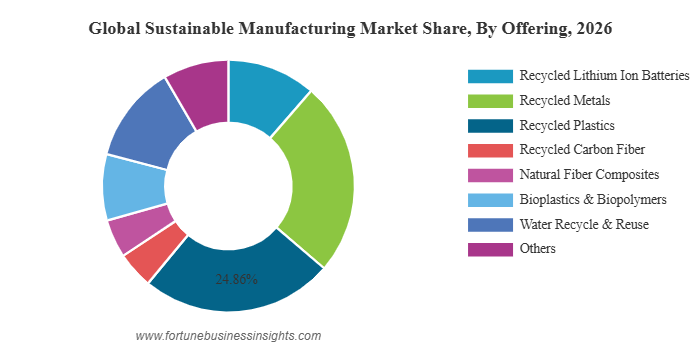
The market is segmented into recycled lithium-ion batteries, recycled metals, recycled plastics, recycled carbon fiber, natural fiber composites, bioplastics and biopolymers, water recycling and reuse, and others.
The recycled metals segment held the largest share in 2026, accounting for 24.86% of the market. This dominance is driven by strong demand for steel, copper, and aluminum feedstock across construction, automotive, and industrial sectors. Established scrap collection networks and lower processing costs compared to primary production further support the segment’s growth.
The recycled lithium-ion batteries segment is expected to record the highest growth rate, driven by the rising adoption of electric vehicles and grid-scale energy storage systems. Increasing end-of-life battery volumes and the high value of critical minerals such as lithium, cobalt, and nickel are encouraging investments in large-scale recycling technologies.
By Industry
Based on industry, the market includes automotive, energy and power, electronics and semiconductors, pharmaceuticals, aerospace and defense, chemicals, packaging, and others.
The automotive segment dominates the market, supported by the growing integration of bioplastics, recycled metals, and energy-efficient production systems. Automakers are establishing circular supply chains for aluminum, steel, and plastics to meet sustainability commitments and carbon reduction targets.
The energy and power segment is projected to grow at the highest rate due to the expansion of renewable energy infrastructure. The shift toward wind, solar, and energy storage systems is increasing demand for sustainably produced components and recycled materials.
Regional Market Insights
Europe
Europe leads the global market, driven by strong environmental regulations, circular economy policies, and substantial public financing for green technologies. The region’s well-established industrial base and advanced recycling infrastructure are accelerating the adoption of sustainable production practices across multiple sectors.
North America
North America is witnessing steady growth due to increasing government support, strict environmental regulations, and rising investments in green technologies. The U.S. is encouraging companies to adopt sustainable manufacturing practices to enhance brand value and meet regulatory requirements.
Asia Pacific
Asia Pacific is expected to record the highest growth rate during the forecast period. Rapid industrialization, rising EV production, and large-scale electrification initiatives are driving demand for battery recycling, retrofit services, and low-carbon materials. China, India, and Japan are key contributors to regional growth.
South America
These regions are experiencing gradual growth due to government programs supporting green industries, increased renewable energy adoption, and technological advancements. GCC countries are investing in sustainable infrastructure, contributing to regional market expansion.
Speak To Analysts: https://www.fortunebusinessinsights.com/enquiry/speak-to-analyst/sustainable-manufacturing-market-112604
Competitive Landscape
The sustainable manufacturing market is highly competitive, with several global players focusing on innovation and green technologies to strengthen their market positions.
Key companies operating in the market include:
3M
Schneider Electric
Siemens AG
Umicore
Unilever
Veolia
BASF
The Dow Chemical Company
General Electric
Toyota
Future Outlook
The global sustainable manufacturing market is expected to expand significantly through 2034, driven by increasing regulatory pressure, consumer demand for eco-friendly products, and advancements in clean technologies. While high initial investment costs remain a challenge, government incentives, circular economy initiatives, and the rapid growth of EV and renewable energy sectors are expected to create substantial growth opportunities.
Ashwin Arora
Fortune Business Insights™ Pvt. Ltd.
+1 833-909-2966
sales@fortunebusinessinsights.com
Legal Disclaimer:
EIN Presswire provides this news content "as is" without warranty of any kind. We do not accept any responsibility or liability for the accuracy, content, images, videos, licenses, completeness, legality, or reliability of the information contained in this article. If you have any complaints or copyright issues related to this article, kindly contact the author above.
