

Nanoparticle-Mediated Photodynamic Therapy Takes on Triple-negative Breast Cancer
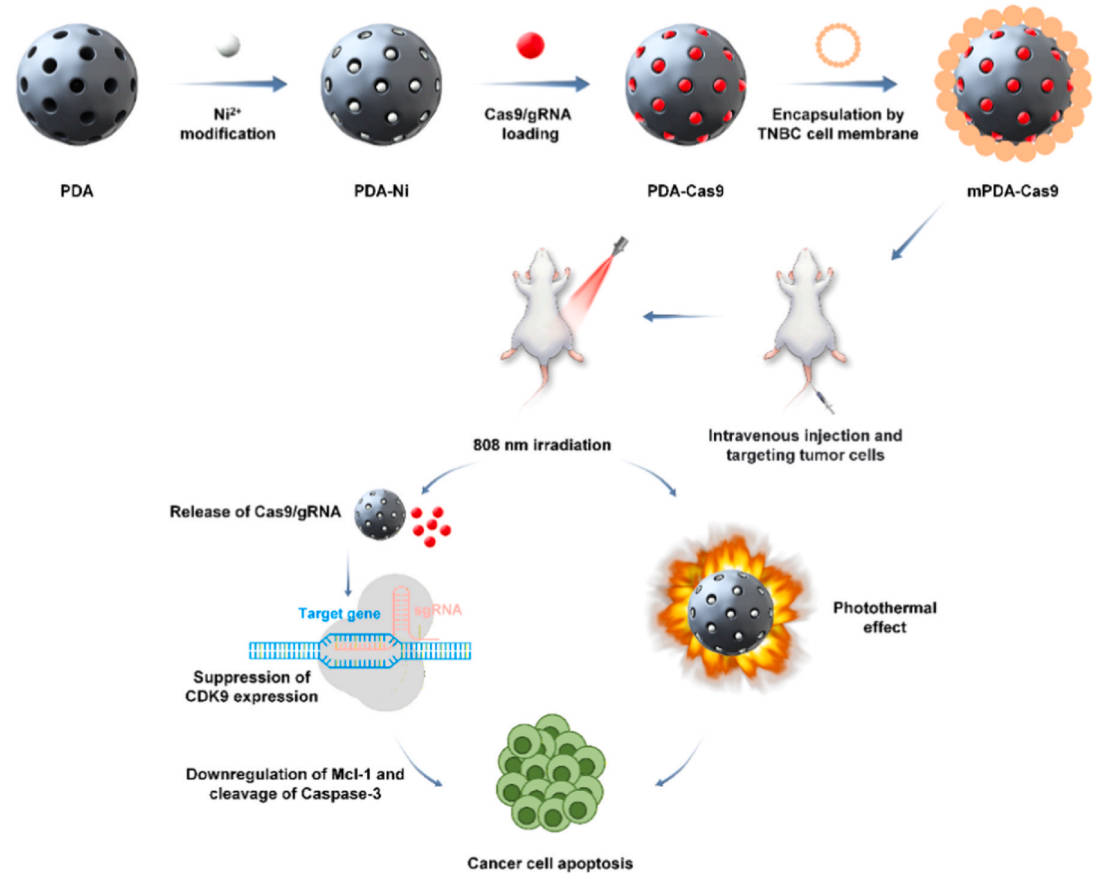
mPDA-Cas9 nanoparticles combine with photothermal therapy target and kill triple-negative Breast Cancer cells.
GA, UNITED STATES, February 4, 2026 /EINPresswire.com/ -- Researchers have developed a new biomimetic nanocomposite (mPDA-Cas9) for treating triple-negative breast cancer (TNBC) by combining CRISPR/Cas9 gene therapy with photothermal therapy. The new nano platform significantly inhibits tumor growth while showing minimal toxicity.
Triple-negative breast cancer (TNBC) is associated with poor survival outcomes and a high risk of recurrence. Standard approaches such as surgery and chemotherapy often fall short, in part because TNBC is highly heterogeneous across patients. These treatments can also carry substantial side effects, underscoring the urgency of developing more effective and better-tolerated options.
In a study published in the KeAi journal Nano Biomedicine and Engineering, researchers from Shanxi Bethune Hospital outline a new treatment approach — a CRISPR/Cas9-based bionic tumor cell membrane-encapsulated nanocomposite, which exhibits excellent biocompatibility and demonstrates outstanding synergistic therapeutic.
“The system combines CRISPR/Cas9 gene editing with photothermal therapy,” shares lead author Yun Li. “The nanocomposite core is made of mesoporous polydopamine, which binds CRISPR/Cas9 complexes via nickel ions and is cloaked in membranes derived from TNBC cells.”
Notably, this "camouflage" allows the particles to evade the immune system and home in on tumor tissue.
“Upon reaching the tumor and being activated by an 808 nm laser, the nanocomposite releases CRISPR/Cas9 to knock down the CDK9 gene — a key cancer driver — while simultaneously generating heat to destroy cancer cells,” Li further explains. “This dual action significantly induces apoptosis and inhibits tumor growth.”
In mouse models, the targeted nanoparticles accumulated effectively in tumors, leading to marked tumor regression and improved survival with no significant toxicity to major organs.
“By disguising nanoparticles with cancer cell membranes, we managed to enhance tumor targeting and therapeutic precision while minimizing off‑target effects,” says Li.
This biomimetic, light‑responsive platform offers a promising strategy for combining gene and thermal therapy against hard‑to‑treat breast cancer. The researchers shared that future work will focus on translating the approach into more clinically relevant models.
Original Source URL
https://doi.org/10.1016/j.nbe.2026.100044
Funding information
This work has been financially supported by the National Key Research and Development Program of China (No.: 2023YFC3402800), National Natural Science Foundation of China (No.: 82120108016), Key Laboratory of Nano-imaging and Drug-loaded Preparation of Shanxi Province (No.: 202104010910010), Shanxi Province Science Foundation for Youths (No.: 20210302124285), Fundamental Research Program of Shanxi Province (No.: 202403021221233), Scientific Research Foundation of Shanxi Bethune Hospital (Nos.: 2021RC015 and 2022RC14), National Natural Science Foundation Seed Player Project of Shanxi Bethune Hospital (No.: 2023GZRZ02). Research and Innovation Team Project for Scientific Breakthroughs at Shanxi Bethune Hospital (No.: 2024ZHANCHI09). Continuous Funding Program for High-Level Research Achievements at Shanxi Bethune Hospital (Nos.: 2024GSPYJ12, 2024GSPYJ15, 2025GSPYJ3, 2025GSPYJ4).
Lucy Wang
BioDesign Research
email us here
Legal Disclaimer:
EIN Presswire provides this news content "as is" without warranty of any kind. We do not accept any responsibility or liability for the accuracy, content, images, videos, licenses, completeness, legality, or reliability of the information contained in this article. If you have any complaints or copyright issues related to this article, kindly contact the author above.
