

Marine Waste-Derived PCR Plastics Market to Surge from USD 1,320 M in 2026 to USD 4,683.1 M by 2036 at 13.5% CAGR
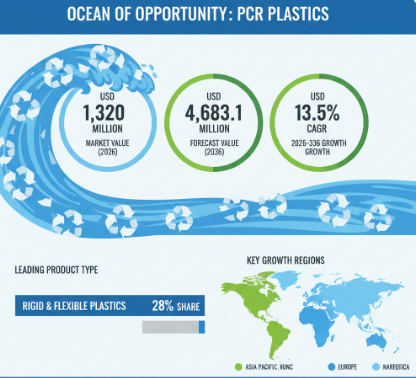
Marine waste PCR plastics market grows rapidly as sustainable recycled materials gain adoption in packaging, driven by traceability, coastal recovery efforts.
NEWARK, DE, UNITED STATES, January 29, 2026 /EINPresswire.com/ -- The marine waste-derived post-consumer recycled (PCR) plastics market is set to expand significantly over the coming decade, driven by rising demand for sustainable materials, greater enterprise commitments to circular economy goals, and advances in feedstock recovery and sorting technologies. According to a newly released market forecast, the industry’s value and adoption trajectory underscore both the economic and environmental relevance of repurposing ocean-bound plastics for commercial applications.
Rapid Market Expansion Reflects Shift Toward Sustainable Feedstocks
Marine waste-derived PCR plastics — resins processed from plastics recovered from ocean, coastal, and near-marine environments — are emerging as differentiated recycled materials that offer traceability and storytelling value to brands beyond traditional post-consumer recycled sources.
The global market is projected to grow at a robust compound annual growth rate (CAGR) through the next decade, led by packaging and consumer goods applications. This growth reflects increasing corporate sustainability commitments and regulatory frameworks that prioritize recycled content and environmental stewardship.
“Marine waste-derived PCR plastics are not just a novel source of recycled polymer inputs,” said one industry analyst. “They represent a strategic convergence of environmental urgency and commercial demand for credible, traceable recycled content.”
Market Drivers: Traceability, Quality, and Brand Differentiation
Unlike typical PCR materials sourced from municipal recycling streams, plastics recovered from marine environments pose unique challenges, including higher contamination loads, variable polymer mixes, and quality variability. Overcoming these complexities hinges on advanced cleaning, deodorization, and quality assurance processes that can produce resins suitable for broad use across packaging, flexible formats, and rigid materials.
Certification and chain-of-custody documentation are increasingly vital to market acceptance, as brand owners seek defensible sustainability claims. These factors also influence adoption timelines, with buyers prioritizing performance data on mechanical properties, melt stability, and processing reliability.
Dominant End Uses and Product Types
Packaging and Consumer Goods Lead Adoption
Packaging and consumer goods sectors dominate end-use demand for marine waste-derived PCR plastics, as repeatable formats and high volume requirements enable easier qualification and integration into existing manufacturing processes. The compatibility with standard extrusion and molding lines enhances adoption rates, particularly for rigid containers, films, and household items.
Rigid and Flexible Plastics Are Most Widely Used
Among product types, rigid and flexible plastics hold a leading position due to their versatility and processing flexibility. These formats accommodate diverse design and performance needs while aligning with established production methods, making them attractive targets for brand and converter adoption.
Regional Dynamics: Growth Across Global Markets
Growth performance varies by region, shaped by differences in waste recovery infrastructure, manufacturing priorities, brand participation, and regulatory environments.
• Asia Pacific: A primary hub for both marine plastic leakage and recycling innovation, this region accounts for a substantial share of revenue and recovery initiatives. Asia Pacific’s coastal density and manufacturing scale support rapid feedstock availability and adoption.
• North America: Brands in the United States are incorporating marine-derived PCR as part of differentiated sustainability narratives, combining marine feedstocks with conventional PCR to balance cost and performance.
• Europe: European markets emphasize quality control, traceability standards, and extended certification frameworks, focusing on integrating marine feedstocks with existing PCR streams.
• India and Other High-Growth Economies: India’s expansive coastlines, emerging recycling clusters, and demand for alternative recycled feedstocks create a rapid growth environment, with scalable processing and supplier support cited as key competitive factors.
Competitive Landscape and Innovation
Key industry players are competing through traceability systems, advanced processing technologies, and documented quality metrics tailored to specific applications. Suppliers emphasize end-to-end capabilities, from coastal and river collection partnerships to pelletizing technologies and blockchain-enabled chain-of-custody tools that support credible sustainability claims.
Among notable approaches are hyperspectral sorting systems and AI-enhanced classification tools that improve recovery yields and feedstock purity, enabling broader application potential beyond low-grade uses.
Market Challenges and Adoption Barriers
Despite robust growth prospects, the marine waste-derived PCR plastics market faces constraints tied to feedstock variability and processing costs. Marine litter streams exhibit a wide range of polymer types and degradation levels, driving the need for specialized washing and quality control to meet performance expectations comparable to conventional PCR resins.
These challenges extend adoption timelines, particularly where rigorous performance and quality benchmarks are prerequisites for industrial and consumer product applications.
Outlook: Sustainability Meets Commercial Value
The marine waste-derived PCR plastics market stands at the intersection of environmental urgency and industrial innovation. As demand for recycled content intensifies and waste recovery systems improve, the sector is positioned to transform coastal and ocean waste into valuable industrial inputs that support circular economy goals.
Request for Sample Report | Customize Report |purchase Full Report – https://www.futuremarketinsights.com/reports/sample/rep-gb-3132
Explore More Related Studies Published by FMI Research:
Pelletized Activated Carbon Market https://www.futuremarketinsights.com/reports/pelletized-activated-carbon-market
Latin America Road Marking Paint & Coating Market https://www.futuremarketinsights.com/reports/road-marking-paint-and-coating-industry-analysis-in-latam
Aluminum Phosphide Market https://www.futuremarketinsights.com/reports/aluminum-phosphide-market
About Future Market Insights (FMI)
Future Market Insights, Inc. (FMI) is an ESOMAR-certified, ISO 9001:2015 market research and consulting organization, trusted by Fortune 500 clients and global enterprises. With operations in the U.S., UK, India, and Dubai, FMI provides data-backed insights and strategic intelligence across 30+ industries and 1200 markets worldwide.
Why Choose FMI: https://www.futuremarketinsights.com/why-fmi
Sudip Saha
Future Market Insights Inc.
+1 347-918-3531
rahul.singh@futuremarketinsights.com
Legal Disclaimer:
EIN Presswire provides this news content "as is" without warranty of any kind. We do not accept any responsibility or liability for the accuracy, content, images, videos, licenses, completeness, legality, or reliability of the information contained in this article. If you have any complaints or copyright issues related to this article, kindly contact the author above.
