

Global CO₂-Reduced Concrete Market Poised to Grow from USD 26.8 M in 2026 to USD 74.1 M by 2036 at 10.7 % CAGR
New market research shows rising adoption of CO₂-reduced concrete driven by embodied carbon specs, supply chain readiness, and residential construction demand.
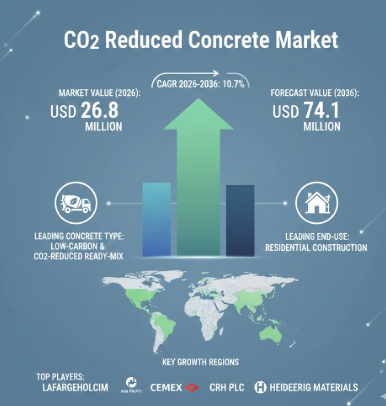
NEWARK, DE, UNITED STATES, January 29, 2026 /EINPresswire.com/ -- According to a new market study by Future Market Insights, the global CO₂-Reduced Concrete Market is projected to expand significantly over the next decade, with total market value growing from USD 26.8 million in 2026 to USD 74.1 million by 2036, representing a compound annual growth rate (CAGR) of 10.7 % from 2026 to 2036.
This comprehensive, data-backed analysis outlines how shifts in construction material specifications, rising emphasis on embodied carbon reduction, and steady adoption across major global regions are shaping demand for concrete products with substantially lower CO₂ emissions.
Market Overview: What Is CO₂-Reduced Concrete?
CO₂-Reduced Concrete refers to concrete formulations engineered to lower embodied carbon through reduced cement content, alternative binders, and carbon capture-informed curing techniques. Rather than relying solely on traditional performance metrics, procurement standards increasingly incorporate measurable emissions profiles alongside compressive strength and durability criteria.
The expanded market forecast reflects the increasing number of projects that specify low-carbon mixes as part of broader sustainability mandates embedded in public tendering, infrastructure funding, and private construction portfolios.
Key Growth Drivers: Why the Market Is Expanding
Embodied Carbon in Procurement
Project specifications that call for reduced embodied carbon have become a major driver in the adoption of CO₂-reduced concrete globally. These specifications affect initial mix acceptance and require rigorous testing for strength, setting times, and durability, which ultimately ties adoption to project pipelines rather than spot material purchases.
This focus on carbon performance is aligned with broader industry decarbonization trends, including new construction codes, green building certifications, and investor scrutiny of lifecycle emissions.
Residential Construction Demand
Residential construction accounts for the largest share of market volume—about 41 %—owing to its repetitive build cycles and growing policy emphasis on lower carbon footprints in housing programs.
In commercial and institutional segments, stricter performance requirements and third-party certifications drive demand for high-performance eco mixes, while infrastructure projects demand mix stability over large pour volumes and long service lives.
Supply Chain Coordination
Reliable coordination among cement manufacturers, supplementary binder suppliers, and admixture providers is crucial to ensure material availability for batching plants. Quality assurance teams and plant managers focus on maintaining workability, slump retention, early strength development, and dispatch scheduling to support seamless field deployment.
As mix designs expand and approvals increase, producers that integrate alternative binders and lower-carbon solutions into standard portfolios are gaining market traction.
Regional Insights: Where Growth Is Concentrated
The Asia Pacific region, Europe, and North America are identified as key markets, with rapid urbanization, infrastructure programs, and emissions reporting frameworks driving adoption.
Country-specific forecasts suggest robust growth in emerging economies, with markets such as India and China leading in adoption rates due to large-scale infrastructure investments and regulatory pressure to reduce construction sector emissions.
Competitive Landscape
Major building materials suppliers and cement groups are positioning themselves to compete on mix performance, consistency, and specification inclusion rather than on price alone. Key companies profiled in the market study include:
• LafargeHolcim
• CEMEX
• CRH plc
• Heidelberg Materials
These firms emphasize product certification, plant-level consistency, and contractor confidence to secure specification roles in long-term programs. Once a CO₂-reduced mix is embedded in project documents, substitution triggers requalification and testing cycles, giving early specification adopters a competitive edge.
Industry Relevance: How This Market Shapes Construction
Concrete is central to structural performance in virtually all construction segments. The shift toward lower-carbon mixes reflects wider sustainability goals and a broader realignment of procurement priorities. Project owners increasingly see CO₂-reduced concrete not as a niche product but as a specification choice embedded in long-term construction quality plans.
Quality documentation, accredited testing, and end-to-end supply readiness are now core factors for selection—underscoring a transition from promotional claims to specification-driven deployment.
Looking Ahead: Risks and Adoption Dynamics
Despite growth momentum, adoption barriers remain, including approval cycle durations, cost sensitivity, and the structural risk management imperative inherent in concrete selection. These forces slow wider acceptance, favoring projects where engineering teams proactively integrate emission standards with traditional performance criteria.
Standardizing mix families that integrate into existing batching and quality control workflows will be key to scaling adoption, as will training programs for field crews and documentation professionals.
Request for Sample Report | Customize Report |purchase Full Report – https://www.futuremarketinsights.com/reports/sample/rep-gb-31349
Explore More Related Studies Published by FMI Research:
Pharmaceutical Solvents Market https://www.futuremarketinsights.com/reports/pharmaceutical-solvents-market
Environmental Remediation Technology Market https://www.futuremarketinsights.com/reports/environmental-remediation-technology-market
Ferrous Sulfate Market https://www.futuremarketinsights.com/reports/ferrous-sulfate-market
About Future Market Insights (FMI)
Future Market Insights, Inc. (FMI) is an ESOMAR-certified, ISO 9001:2015 market research and consulting organization, trusted by Fortune 500 clients and global enterprises. With operations in the U.S., UK, India, and Dubai, FMI provides data-backed insights and strategic intelligence across 30+ industries and 1200 markets worldwide.
Why Choose FMI: https://www.futuremarketinsights.com/why-fmi
Sudip Saha
Future Market Insights Inc.
+1 347-918-3531
rahul.singh@futuremarketinsights.com
Legal Disclaimer:
EIN Presswire provides this news content "as is" without warranty of any kind. We do not accept any responsibility or liability for the accuracy, content, images, videos, licenses, completeness, legality, or reliability of the information contained in this article. If you have any complaints or copyright issues related to this article, kindly contact the author above.
