

Carbon Steel Market Set to Expand from USD 1,140.2 Billion in 2025 to USD 1,687.8 Billion by 2035 at 4.0% CAGR
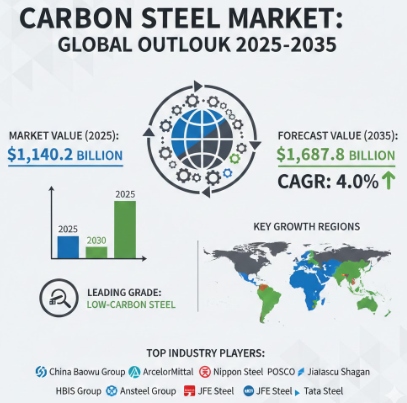
Global carbon steel demand grows driven by infrastructure, automotive, and energy sectors with strong market fundamentals and long-term industrial relevance.
NEWARK, DE, UNITED STATES, January 28, 2026 /EINPresswire.com/ -- The global carbon steel market is projected to grow from USD 1,140.2 billion in 2025 to USD 1,687.8 billion by 2035, registering a compound annual growth rate (CAGR) of 4.0 % over the next decade, according to a comprehensive industry forecast by Future Market Insights. This expansion reflects sustained demand across construction, automotive, machinery, and energy sectors, with low-carbon steel products capturing the majority of market share owing to their versatility and cost efficiency.
Who and What: Market Size, Scope, and Key Drivers
The carbon steel market comprises a range of grades — low, medium, and high carbon — each tailored to specific industrial applications. Low-carbon steel dominates the landscape with broad adoption for structural and fabrication uses, while medium-carbon and high-carbon steels serve machinery and tools where enhanced strength and wear resistance are required.
Key demand drivers include:
• Infrastructure investment in emerging and mature economies
• Automotive production growth integrating high-strength steel into vehicle platforms
• Expansion of manufacturing activity for heavy machinery and industrial equipment
These factors underpin market fundamentals, reinforcing carbon steel’s role as an essential industrial material.
Where and When: Geographic Trends and Forecast Timeline
The Asia Pacific region — home to major steel producers and end-use markets — remains the largest revenue contributor, supported by robust manufacturing ecosystems and rapid infrastructure development. North America and Europe also exhibit steady growth driven by domestic infrastructure initiatives and re-shoring of manufacturing capacity.
The forecast period spans 2025–2035, during which the market is expected to generate approximately USD 547.5 billion in new revenue opportunities across key sectors.
Why It Matters: Industry Relevance and Economic Impact
Carbon steel is foundational to global industrial activity due to its strength, weldability, cost efficiency, and recyclability. These characteristics make it indispensable in:
• Building and construction, where structural beams and reinforcement bars are critical
• Automotive manufacturing, especially body panels and chassis components
• Machinery and equipment fabrication
Its broad application base bolsters economic infrastructure and supports industrial value chains worldwide.
Recent macroeconomic data supports sustained industrial demand. For instance, India’s crude steel output surged over 10 % in 2025, highlighting robust activity in one of the industry’s fastest-growing markets.
How the Market Will Evolve: Growth Patterns and Competitive Dynamics
Market segmentation data indicate that flat products — favored for continuous processing and surface quality — account for the largest volume share, particularly in automotive and construction applications. Beyond flat products, new opportunities are emerging in sectors such as shipbuilding, renewable energy infrastructure, and advanced mechanical engineering.
A moderately concentrated competitive landscape includes major producers such as:
• China Baowu Group
• ArcelorMittal
• Nippon Steel
• POSCO
• HBIS Group
• Tata Steel
These firms leverage scale, supply-chain integration, and metallurgical innovation to meet diverse industrial requirements while responding to evolving standards for performance and sustainability.
Market Context: Broader Industry and Sustainability Trends
Global steel production and consumption patterns are influenced by shifting regional dynamics and policy considerations. For example, China has recently adjusted production strategies to address overcapacity and environmental targets, while other nations, including India and Vietnam, are expanding output to serve growing demand.
Environmental considerations continue to shape the sector. Efforts toward decarbonization, adoption of electric arc furnace technology, and regulatory measures such as carbon pricing in major markets are beginning to influence production pathways and cost structures. These trends will likely affect supply chains and investment patterns through the forecast period.
Strategic Implications for Stakeholders
For industry leaders, investors, and market analysts, understanding the carbon steel market’s projected trajectory is critical for:
• Assessing capital allocation in infrastructure and manufacturing sectors
• Identifying technology and capacity expansion opportunities
• Benchmarking competitive performance across regions and product segments
Market fundamentals indicate that carbon steel will remain integral to industrial growth, with its demand closely tied to macroeconomic activity and long-term infrastructure commitments globally.
Request for Sample Report | Customize Report |purchase Full Report – https://www.futuremarketinsights.com/reports/sample/rep-gb-307
Explore More Related Studies Published by FMI Research:
Asia Neopentyl Glycol (NPG) Market https://www.futuremarketinsights.com/reports/asia-neopentyl-glycol-market
Polypropylene Random Copolymers Market https://www.futuremarketinsights.com/reports/polypropylene-random-copolymers-market
Esters Market https://www.futuremarketinsights.com/reports/esters-market
About Future Market Insights (FMI)
Future Market Insights, Inc. (FMI) is an ESOMAR-certified, ISO 9001:2015 market research and consulting organization, trusted by Fortune 500 clients and global enterprises. With operations in the U.S., UK, India, and Dubai, FMI provides data-backed insights and strategic intelligence across 30+ industries and 1200 markets worldwide.
Why Choose FMI: https://www.futuremarketinsights.com/why-fmi
Sudip Saha
Future Market Insights Inc.
+1 347-918-3531
rahul.singh@futuremarketinsights.com
Legal Disclaimer:
EIN Presswire provides this news content "as is" without warranty of any kind. We do not accept any responsibility or liability for the accuracy, content, images, videos, licenses, completeness, legality, or reliability of the information contained in this article. If you have any complaints or copyright issues related to this article, kindly contact the author above.
