

Global Biodegradable Wrap Systems Market to Reach USD 1.8 Billion by 2036 on Rising Plastic Reduction Mandates | FMI
Biodegradable Wrap Systems Market
Eco-friendly packaging in the USA is growing at a 10.4% CAGR, driven by plastic reduction initiatives, infrastructure investment, and rising consumer awareness.
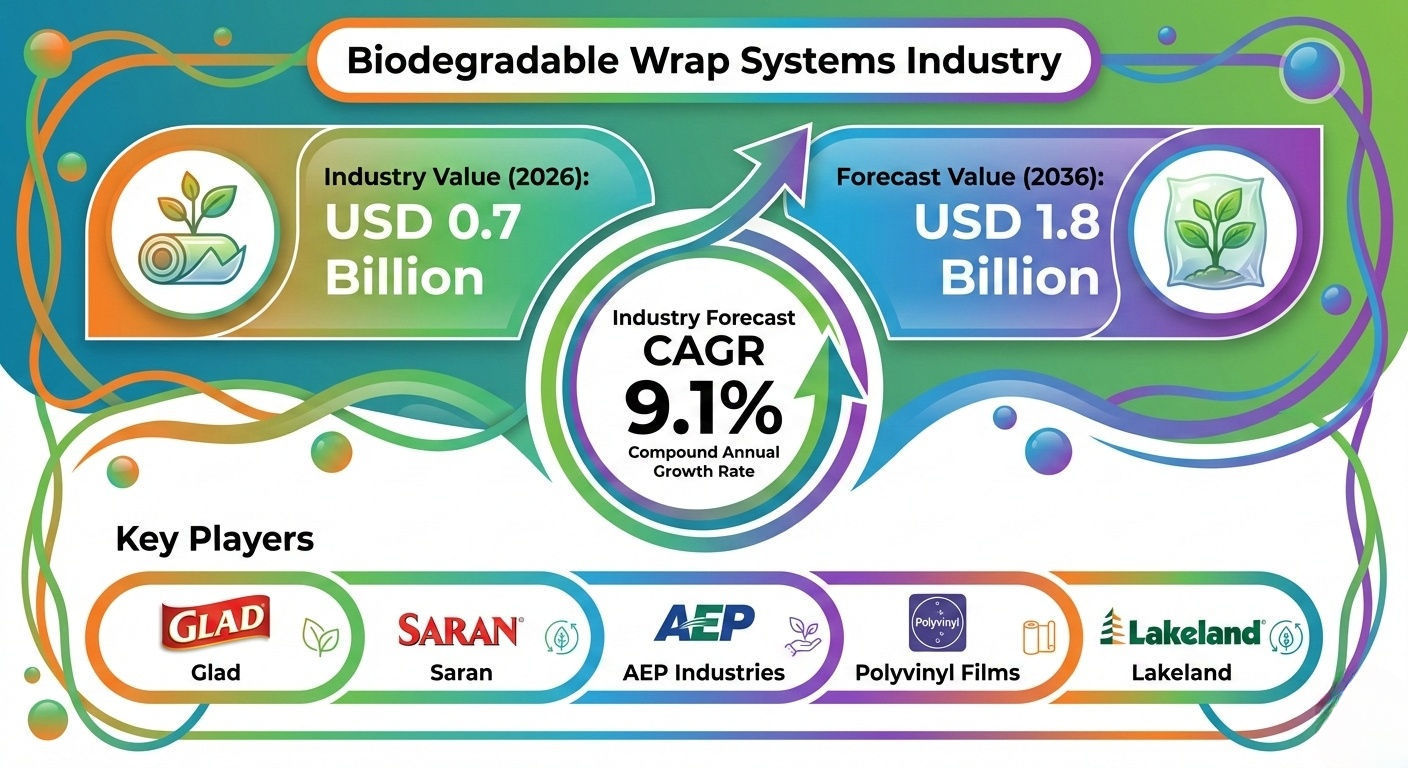
NEWARK, DE, UNITED STATES, January 28, 2026 /EINPresswire.com/ -- The global biodegradable wrap systems market is entering a decisive growth phase as regulatory pressure, environmental awareness, and material innovation converge to accelerate the replacement of conventional plastic food wraps. According to updated analysis by Future Market Insights (FMI), the market is projected to reach USD 0.7 billion in 2026 and expand at a compound annual growth rate (CAGR) of 9.1% through 2036, reaching an estimated USD 1.8 billion by the end of the forecast period.
The outlook reflects a measurable shift in both household and commercial food packaging toward certified compostable and biodegradable solutions, driven by plastic reduction mandates, circular economy targets, and rising scrutiny of microplastic exposure.
Discover Growth Opportunities in the Market – Get Your Sample Report Now
https://www.futuremarketinsights.com/reports/sample/rep-gb-31759
Market Snapshot: Who, What, When, Where, Why, and How
Who: Packaging manufacturers, foodservice operators, retailers, and sustainability-driven consumers
What: Global biodegradable wrap systems used in food storage and preparation
When: Forecast period from 2026 to 2036
Where: Growth concentrated in Germany, the United States, Japan, Canada, and France
Why: Regulatory action on single-use plastics and demand for low-waste consumption
How: Advances in plant-based biomaterials, certification, and compostability validation
Key Market Metrics at a Glance
• Market Size (2026): USD 0.7 billion
• Forecast Value (2036): USD 1.8 billion
• Forecast CAGR (2026–2036): 9.1%
• Leading Material Type: Plant-based wraps (34.7% share)
• Leading Application: Food storage (29.3% share)
• Preferred Thickness Category: Standard thickness wraps (45.2% share)
• Key Growth Regions: Germany, United States, Japan
Market Context: Sustainability Moves from Niche to Procurement Standard
Concerns around plastic pollution and long-term microplastic exposure are increasingly influencing purchasing decisions across developed markets. FMI analysis indicates that biodegradable wrap systems are no longer positioned solely as premium eco-products; instead, they are becoming mainstream substitutes in markets where consumers, retailers, and foodservice operators prioritize plastic-free packaging.
Regulatory frameworks aimed at reducing single-use plastics are reinforcing adoption, while public initiatives and waste reduction programs are improving consumer familiarity with compostable materials. Higher willingness to pay for sustainable packaging in mature economies is supporting wider retail availability and consistent volume growth.
Supply-Side Evolution: Biomaterial Innovation Shapes Competitive Advantage
Manufacturers are responding by investing in next-generation biopolymers that improve barrier performance, heat tolerance, and sealing characteristics without compromising biodegradability. Material development is shifting decisively away from petroleum-based films toward plant-derived inputs, including cellulose and starch-based structures.
This transition is expanding product portfolios across:
• Rolls and sheets for household use
• Compostable wraps for foodservice operations
• Reusable formats designed for durability and moisture control
Competition is increasingly defined by certification strength, transparency, and consistency, rather than branding alone.
Why Plant-Based Wraps Lead Material Demand
Plant-based wraps are expected to account for 34.7% of market share in 2026, supported by their alignment with compostability requirements and broad acceptance in food-contact applications. Their leadership reflects:
• Strong compatibility with home and industrial composting
• Certification that validates biodegradability claims
• Cleaner processing that improves compliance and consistency
FMI notes that improvements in cellulose extraction and material calibration are strengthening performance in real-world food storage conditions, reinforcing buyer confidence.
Standard Thickness Wraps Set the Performance Benchmark
By thickness and quality, standard thickness wraps are projected to hold a 45.2% share in 2026. These formats balance durability with predictable biodegradation, offering reliable barrier properties for routine household and commercial use.
Key adoption drivers include:
• Consistent moisture protection
• Improved handling strength versus ultra-thin options
• Tighter manufacturing tolerances for repeatability
Food Storage Remains the Primary Application
Food storage is expected to represent 29.3% of total demand in 2026, reflecting its high-frequency use in households and small food operations. Consumers are increasingly choosing biodegradable wraps to reduce plastic use while maintaining freshness, hygiene, and refrigeration compatibility.
Regional Outlook: Policy Alignment Drives Market Expansion
• Germany leads growth with an 11.2% CAGR, underpinned by strict environmental regulations and advanced composting infrastructure.
• United States demand is projected to grow at 10.4% CAGR, supported by state-level plastic reduction initiatives and expanding waste management systems.
• Japan is forecast to grow at 9.8% CAGR, driven by marine pollution awareness and strong biodegradation verification standards.
• Canada and France follow, with growth supported by municipal composting programs and EU-aligned sustainability directives.
Competitive Landscape: Certification and Performance Define Market Position
Competition in biodegradable wrap systems is increasingly shaped by:
• Verified compostability and biodegradation certification
• Application-specific performance for moisture control and sealing
• Alignment with municipal waste handling rules
Established brands including Glad, Saran, AEP Industries, Polyvinyl Films, and Lakeland are investing in research collaborations and certification programs to strengthen regulatory acceptance. FMI notes that partnerships with waste management organizations and targeted biomaterial innovation are emerging as critical levers for sustained market access.
Outlook: Evidence-Based Sustainability Will Define the Next Decade
FMI projects that continued tightening of plastic reduction regulations, combined with harmonization of compostability standards, will sustain long-term growth. As evidence requirements rise, manufacturers are expected to invest further in controlled composting studies and transparent documentation, reinforcing biodegradable wraps as a credible, scalable alternative to conventional plastic films.
Why FMI: https://www.futuremarketinsights.com/why-fmi
Have a Look at Related Research Reports on the Packaging Domain:
Foil Labels Market https://www.futuremarketinsights.com/reports/foil-labels-market
Track And Trace Packaging https://www.futuremarketinsights.com/reports/track-and-trace-packaging-market
Mineral Wool Market https://www.futuremarketinsights.com/reports/mineral-wool-market
Wrap-Around Label Market https://www.futuremarketinsights.com/reports/wrap-around-labels-market
Demand for Heavy Duty Bag and Sack in the UK https://www.futuremarketinsights.com/reports/united-kingdom-heavy-duty-bag-and-sack-market
About Future Market Insights (FMI)
Future Market Insights, Inc. (FMI) is an ESOMAR-certified, ISO 9001:2015 market research and consulting organization, trusted by Fortune 500 clients and global enterprises. With operations in the U.S., UK, India, and Dubai, FMI provides data-backed insights and strategic intelligence across 30+ industries and 1200 markets worldwide.
Sudip Saha
Future Market Insights Inc.
+1 347-918-3531
email us here
Legal Disclaimer:
EIN Presswire provides this news content "as is" without warranty of any kind. We do not accept any responsibility or liability for the accuracy, content, images, videos, licenses, completeness, legality, or reliability of the information contained in this article. If you have any complaints or copyright issues related to this article, kindly contact the author above.
