

From Shelter to Self-Actualization: Evolve Development Shows How Buildings Can Last 500 Years
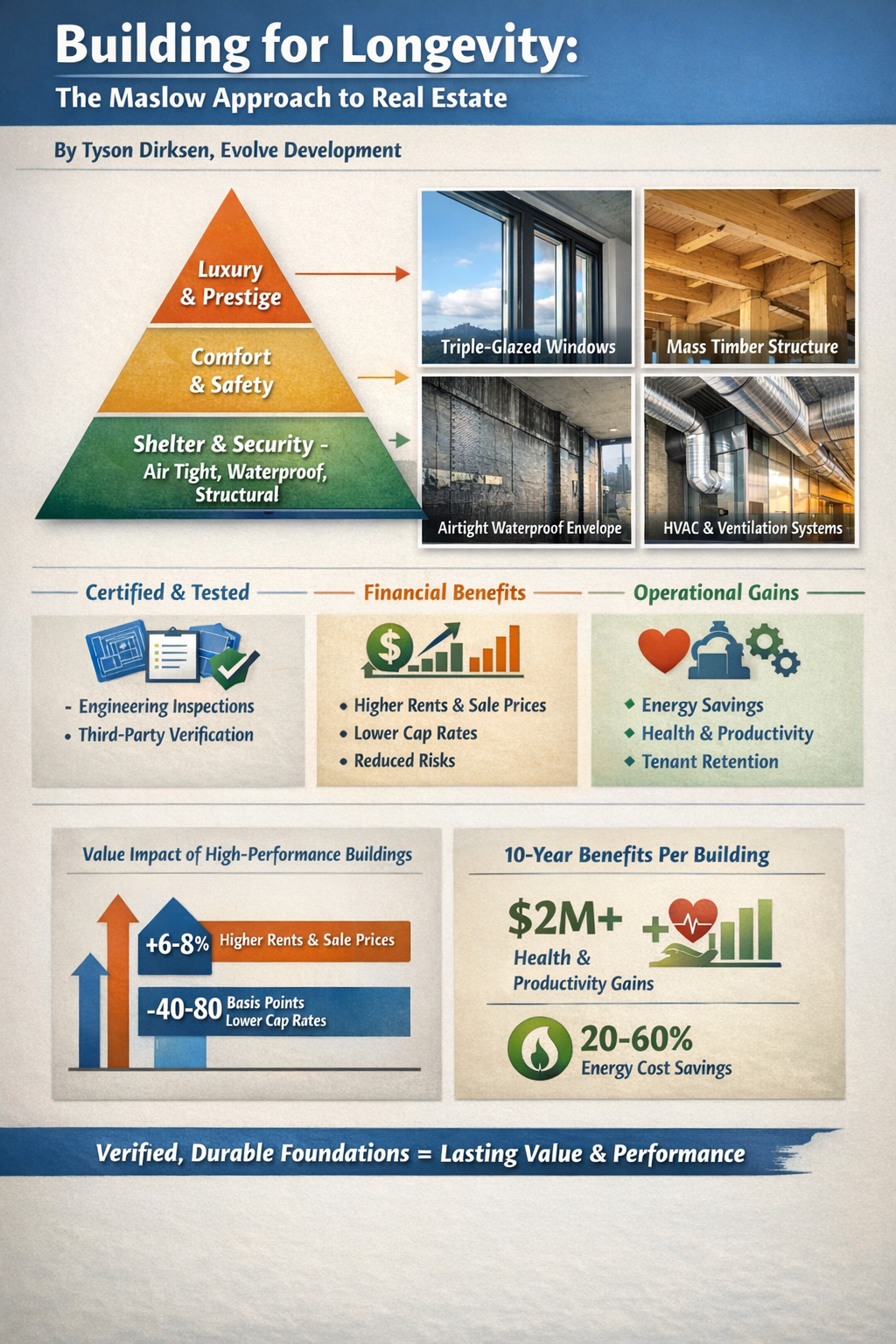
Maslow-Inspired Building Triangle: How high-performance design secures long-term value, operational efficiency, and tenant satisfaction in real estate.
Evolve Development highlights verified 500-year mid-rise buildings that deliver long-term value, lower risk, and higher investor returns.
SAN FRANCISCO, CA, UNITED STATES, February 3, 2026 /EINPresswire.com/ -- From Shelter to Self-Actualization: Evolve Development Publishes Framework for 500-Year High-Performance Mid-Rise BuildingsA new thought leadership paper reframes real estate value around durability, health, and verified performance—not finishes alone
Tyson Dirksen, founder of Evolve Development, has released a new thought leadership paper titled “From Shelter to Self-Actualization: Building 500-Year Mid-Rise Mixed-Use High-Performance Buildings That Last.” The paper outlines a systems-based framework for designing, documenting, and certifying high-performance mid-rise buildings that reduce risk, protect occupant health, and deliver superior long-term financial performance.
The paper argues that most real estate value discussions are inverted—prioritizing finishes, branding, and short-term aesthetics while underinvesting in the fundamental systems that actually determine durability, operational stability, and lifecycle returns.
Drawing on building science, investment data, and construction best practices, the paper positions the building enclosure and mechanical systems as the true foundation of value, analogous to the base of Maslow’s hierarchy of needs.
“Just as people cannot reach self-actualization without first meeting basic needs like shelter and safety, buildings cannot sustain high rents, low cap rates, or premium valuations without a proven, durable foundation,” said Dirksen. “Luxury finishes sit at the top of the pyramid—but they only matter if the base is sound.”
A Data-Backed Case for High-Performance Buildings
The paper highlights research showing that verified high-performance buildings consistently outperform conventional assets:
4–20% higher rents and up to 16% higher sales prices compared to non-certified peers
Cap rate compression of 40–80 basis points, reflecting lower perceived operational and litigation risk
20–60% reductions in energy use, improving net operating income and long-term cash flow
Improved indoor air quality and thermal comfort associated with lower absenteeism and productivity gains valued at $50 per square foot per year, often dwarfing energy savings alone
The analysis also underscores a critical but often misunderstood risk: air intrusion, not vapor diffusion, is the dominant pathway for moisture damage. According to Building Science Corporation, air leakage through a one-square-inch opening can transport nearly 90 times more moisture into an assembly than vapor diffusion through an entire sheet of gypsum board over a heating season—making airtightness essential to durability, not optional.
Why Verification Matters
A central thesis of the paper is that performance cannot be assumed—it must be proven.
Evolve Development calls for a standardized, building-level certification framework requiring:
Architectural, structural, mechanical, and civil engineering details
Construction photography documenting installation, connections, and critical transitions
Commissioning and performance testing of enclosure and mechanical systems
Third-party sign-off by qualified building scientists or envelope specialists
This documentation, the paper argues, should remain with the building for its entire life—functioning as a building-level “warranty,” similar to the documentation that accompanies high-performance vehicles or aircraft.
“Most buyers evaluate buildings based on what they can see,” Dirksen added. “But it’s the unseen failures—water intrusion, poor air quality, thermal instability—that create the most expensive problems later. Savvy investors should require proof, not promises.”
A Shift Toward Long-Term, Low-Risk Real Estate
Rather than positioning high-performance buildings as a sustainability premium, the paper reframes them as risk-mitigated infrastructure assets—particularly relevant for pension funds, family offices, and long-term holders seeking durable cash flow and resilience in changing climate and regulatory environments.
The framework is intended to support 500-year building lifespans, especially for mid-rise, transit-oriented mixed-use developments where replacement costs, embodied carbon, and social disruption are highest.
Read the Full Paper
The full article, “From Shelter to Self-Actualization: Building 500-Year Mid-Rise Mixed-Use High-Performance Buildings That Last,” is available at:
https://evolve-us.com/high-performance-buildings/
About Evolve Development
Evolve Development is a San Francisco–based real estate development firm specializing in high-performance mid-rise mixed-use buildings. The company integrates building science, mass timber construction, advanced envelopes, and verified mechanical systems to deliver durable, healthy, and financially resilient urban assets.
Tyson Dirksen, TysonDirksen.com
Evolve Development, evolve-us.com
+1 415-231-4112
info@evolve-us.com
Visit us on social media:
LinkedIn
Instagram
Facebook
YouTube
X
Other
Legal Disclaimer:
EIN Presswire provides this news content "as is" without warranty of any kind. We do not accept any responsibility or liability for the accuracy, content, images, videos, licenses, completeness, legality, or reliability of the information contained in this article. If you have any complaints or copyright issues related to this article, kindly contact the author above.
