

High Performance Defoamers Market Forecast 2026–2036: Stable Growth Driven by Industrial Process Demand
High Performance Defoamers Market
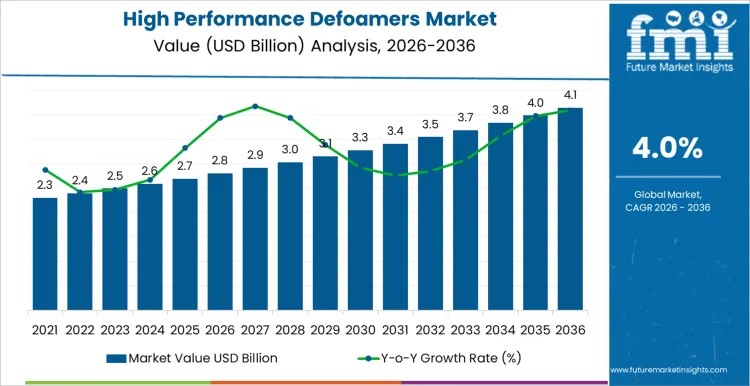
Global high performance defoamers market to grow USD 4.1 billion by 2036 at a 4.0% CAGR, led by silicone chemistries and industrial applications.
NEWARK, DE, UNITED STATES, January 19, 2026 /EINPresswire.com/ -- The global high performance defoamers market is projected to expand from USD 2.8 billion in 2026 to USD 4.1 billion by 2036, registering a compound annual growth rate (CAGR) of 4.00%. Demand remains concentrated in a defined set of industrial end uses—industrial process chemicals, coatings, pulp and paper, food processing, and wastewater treatment—where foam control is operationally essential rather than discretionary.
Market growth is being shaped less by broad volume expansion and more by incremental gains tied to throughput optimization, regulatory compliance, and continuous processing efficiency. End users favor validated defoamers that integrate into existing systems without disrupting product quality, reinforcing long qualification cycles and conservative purchasing behavior. As a result, baseline consumption remains stable, while upside potential is constrained by process design and compatibility requirements.
Request For Sample Report | Customize Report |purchase Full Report - https://www.futuremarketinsights.com/reports/sample/rep-gb-31521
Market Context and Performance Outlook
High performance defoamers are engineered to rapidly collapse surface foam and prevent reformation under high-shear, high-temperature, and chemically aggressive conditions. Foam formation disrupts fluid handling, reduces effective tank capacity, interferes with sensors, and increases the risk of surface defects in coatings, paper, and food processing. In wastewater treatment, uncontrolled foam can impair aeration efficiency and operational stability.
The market’s growth quality is incremental rather than disruptive. Continuous and recurring industrial operations provide predictable demand, while adoption is governed by process reliability rather than formulation experimentation. Switching costs remain meaningful due to surface-quality considerations and formulation compatibility, reinforcing long-term supplier relationships.
Market Statistics
• Market Value (2026): USD 2.8 Billion
• Forecast Value (2036): USD 4.1 Billion
• Forecast CAGR (2026–2036): 4.00%
• Leading Chemistry: Silicone-Based Defoamers (40% share)
• Leading Application: Industrial Process Chemicals (32% share)
• Key Growth Regions: Asia Pacific, Europe, North America, Latin America, Middle East & Africa
Why Industrial Process Control Is Driving Demand
Manufacturers across process industries are prioritizing tighter operational control, higher throughput, and consistent product quality. Foam formation directly affects reaction efficiency, heat transfer, and equipment utilization. High performance defoamers enable stable processing in coatings, adhesives, industrial fermentation, pulp and paper, and chemical manufacturing by delivering rapid foam knockdown and sustained suppression at low dosage levels.
Procurement decisions are increasingly shaped by dispersion efficiency, longevity of foam control, compatibility with surfactant systems, and minimal impact on surface properties. In water-based coatings and adhesives, defoamers must prevent defects such as craters and pinholes without affecting gloss or film integrity. In food and beverage processing, compliance with food-contact and safety regulations is mandatory, while maintaining performance under thermal and mechanical stress.
Market Structure by Chemistry and Application
The high performance defoamers market is segmented by chemistry and application. Silicone-based defoamers dominate with a 40% market share due to their low surface tension, stability across wide temperature and pH ranges, and consistent performance at low dosages. Other chemistries include mineral oil-based defoamers and polymeric or synthetic types, each optimized for specific process environments.
By application, industrial process chemicals account for 32% of total demand, reflecting the sensitivity of chemical manufacturing to foam-related disruptions. Coatings and inks, food and beverage processing, pulp and paper, and wastewater treatment represent other major segments where foam control is critical to operational continuity.
Regional and Country-Level Growth Trends
Asia Pacific remains a key growth region, led by China, which is expanding at a CAGR of 5.2% from 2026 to 2036. Growth is driven by rising industrial coatings output, pulp and paper production, wastewater treatment capacity, and large-scale chemical manufacturing. Procurement priorities in China emphasize cost efficiency, supply reliability, and compatibility with water-based and solvent-based systems.
Brazil is forecast to grow at a CAGR of 4.8%, supported by expansion in pulp and paper, food processing, and municipal wastewater treatment.
The United States is expected to grow at 3.7%, with demand concentrated in coatings, adhesives, and water treatment, where performance consistency and regulatory compliance are key.
Germany’s market is projected to expand at 3.6%, reflecting demand from automotive coatings and specialty chemical production.
South Korea is forecast to grow at 3.2%, driven by electronics manufacturing, industrial coatings, and precision processing applications.
Competitive Landscape and Supplier Positioning
Competition in the high performance defoamers market is defined by predictable defoaming performance, formulation safety, and application-specific reliability. Leading companies include Evonik Industries AG, BASF SE, Dow Chemical Company, Solvay SA, Clariant AG, Ashland Global, Momentive Performance Materials, Elkem Silicones, Wacker Chemie AG, and Elementis Plc.
Global suppliers differentiate through chemistry choice, technical service support, and the ability to customize formulations for evolving industrial processes. Silicone specialists such as Momentive, Elkem, and Wacker Chemie dominate high-durability systems, while diversified chemical companies emphasize balanced performance across silicone and non-silicone portfolios.
Outlook Through 2036
The high performance defoamers market is expected to maintain steady, incremental growth through 2036, supported by continuous industrial operations, tightening process-efficiency standards, and regulatory pressure for low-VOC and environmentally safer formulations. While formulation complexity and compatibility challenges will continue to restrain rapid adoption, sustained demand from coatings, pulp and paper, wastewater treatment, and food processing will reinforce the market’s role as a critical input for efficiency-driven production environments.
Browse Related Insights
Fluorosilicic Acid Market https://www.futuremarketinsights.com/reports/fluorosilicic-acid-market
Fluorinated Ethylene Propylene (FEP) Market https://www.futuremarketinsights.com/reports/fluorinated-ethylene-propylene-fep-market
Monolithic Ceramics Market https://www.futuremarketinsights.com/reports/monolithic-ceramics-market
About Future Market Insights (FMI)
Future Market Insights, Inc. (FMI) is an ESOMAR-certified, ISO 9001:2015 market research and consulting organization, trusted by Fortune 500 clients and global enterprises. With operations in the U.S., UK, India, and Dubai, FMI provides data-backed insights and strategic intelligence across 30+ industries and 1200 markets worldwide.
Sudip Saha
Future Market Insights Inc.
+1 347-918-3531
email us here
Legal Disclaimer:
EIN Presswire provides this news content "as is" without warranty of any kind. We do not accept any responsibility or liability for the accuracy, content, images, videos, licenses, completeness, legality, or reliability of the information contained in this article. If you have any complaints or copyright issues related to this article, kindly contact the author above.
