

Ventilated Balance Enclosure Market Reach USD 1,259.2 Mn by 2036 as labs prioritize weighing accuracy & operator safety
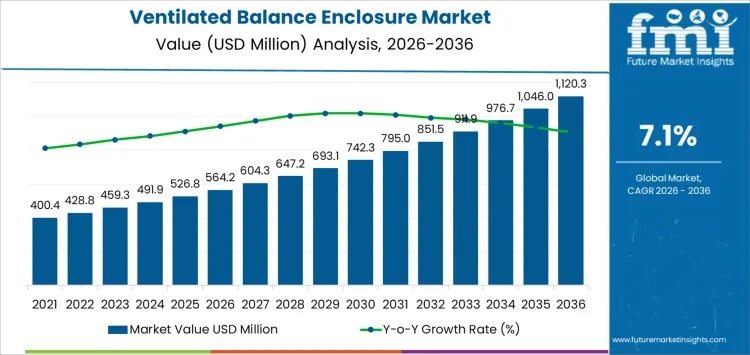
Ventilated Balance Enclosure Market
Ventilated balance enclosure market expands steadily as laboratories strengthen weighing accuracy, airflow control, and operator safety standards worldwide
NEWARK, DE, UNITED STATES, January 16, 2026 /EINPresswire.com/ -- The global ventilated balance enclosure market is projected to grow from USD 564.2 million in 2026 to USD 1,259.2 million by 2036, expanding at a compound annual growth rate (CAGR) of 7.1%, according to the latest market assessment updated on 15 January 2026. Growth is driven not by routine laboratory furniture replacement, but by changes in laboratory methods, safety requirements, and room reconfiguration projects that embed enclosures into validated weighing workflows.
Explore trends before investing – request a sample report today! https://www.futuremarketinsights.com/reports/sample/rep-gb-31374
Market Context: Why Ventilated Balance Enclosures Matter
Ventilated balance enclosures are designed to provide controlled, low-turbulence airflow around analytical balances while containing powders and vapors. They are widely used in pharmaceutical quality control, biotech research, chemical analysis, and materials testing laboratories where trace weighing accuracy and operator protection must be achieved simultaneously.
Unlike general laboratory furniture, purchase decisions typically begin with the weighing task itself. Factors such as powder toxicity class, airflow stability, and balance sensitivity define the performance envelope. Once a method is approved, enclosure size, filter class, and exhaust routing become part of the formal laboratory procedure, making these systems long-lived infrastructure assets rather than interchangeable equipment.
Growth Outlook Through 2036
In 2026, demand is concentrated in pharmaceutical, biotech, and regulated chemical laboratories where powder handling creates exposure and contamination risks. Enclosures are selected during lab fit-out or major refurbishment, tying demand to capital planning cycles rather than short-term replacement. Utilization continues to rise as laboratories migrate weighing activities away from open benches and as audits impose tighter controls on airborne contamination.
By 2036, as market value approaches USD 1.26 billion, buyer focus shifts toward lifecycle performance. Airflow stability, vibration control, ease of cleaning validation, and dependable service coverage become critical. Filter loading and fan drift can affect weighing stability, increasing the importance of maintenance, certification, and repeatable performance under door movement and routine use. Growth reflects accumulated upgrades across thousands of laboratories rather than a single investment wave.
Key Market Metrics at a Glance
• Market Value (2026): USD 564.2 million
• Forecast Value (2036): USD 1,259.2 million
• CAGR (2026–2036): 7.1%
• Leading Product Type: Ducted balance enclosures
• Leading Application: Pharma and biotech laboratories
• Key Regions: Asia Pacific, North America, Europe
Product Type Dynamics: Ducted vs. Ductless Systems
Ducted balance enclosures account for around 56% of global demand. These systems integrate directly with building exhaust infrastructure, delivering predictable airflow behavior under variable powder loading. They are preferred in facilities where containment reliability and stable performance outweigh installation complexity.
Ductless or filtered enclosures are selected where exhaust capacity is limited or where flexibility and relocation are required. However, they introduce ongoing obligations related to filter qualification, breakthrough monitoring, and consumable management. Once a laboratory is validated with a specific configuration, changes are avoided due to the need to revise room balance documentation and safety approvals. As a result, product type demand closely follows laboratory ventilation strategy rather than short-term purchasing preferences.
Application Trends: Regulated Labs Drive Volume
Pharmaceutical and biotech laboratories represent approximately 61% of market demand, reflecting frequent weighing and dispensing of potent compounds under strict occupational exposure limits. These facilities deploy multiple enclosures per site and emphasize standardized footprints, documentation, and service procedures.
Academic and research laboratories operate at smaller scale with more varied specifications, resulting in lower unit volumes but broader configuration diversity. Service and maintenance activity—filter replacement, airflow verification, and recertification—adds lifecycle value but does not significantly drive new unit sales.
Regional Growth Patterns
Demand growth varies by country, reflecting differences in laboratory expansion, regulation, and safety formalization:
• India: 10.7% CAGR, driven by pharmaceutical manufacturing, contract research, and compliance upgrades
• China: 10.5% CAGR, supported by industrial R&D and life sciences lab construction
• Brazil: 10.0% CAGR, led by private laboratory expansion and compounding facilities
• United States: 9.5% CAGR, shaped by upgrades to safety-compliant lab infrastructure
• Germany: 7.7% CAGR, reflecting mature but steady modernization demand
Competitive Landscape and Buying Behavior
Competition centers on airflow uniformity, build tolerances, installation accuracy, and service reliability rather than catalog breadth or price promotions. Leading players include Labconco, Thermo Fisher Scientific, Erlab, Esco, and Air Science. Integrators often supply enclosures alongside analytical balances and vibration control tables, adding value through site assessment, installation, and performance verification.
Once an enclosure model is approved within a laboratory standard, repeat installations follow across multiple rooms and sites. Profitability is shaped by low rework, dependable field support, and alignment with laboratory standardization programs rather than rapid turnover.
Buy Report Now – Click Here to Purchase the Report: https://www.futuremarketinsights.com/checkout/31374
Long Equipment Lifetimes Shape Market Structure
Ventilated balance enclosures are durable assets with long service lives, limiting routine replacement demand. Capital budgets also prioritize analytical instruments, making enclosure upgrades most likely during lab expansions or refurbishments. These dynamics concentrate demand around planned projects and reinforce the market’s steady, infrastructure-driven growth profile.
Browse Related Insights
Light Scattering Systems Market: https://www.futuremarketinsights.com/reports/light-scattering-systems-market
Steroid Measurements Reagents Market: https://www.futuremarketinsights.com/reports/steroid-measurements-reagents-market
Liquid Nitrogen Biological Containers Market: https://www.futuremarketinsights.com/reports/liquid-nitrogen-biological-containers-market
About Future Market Insights (FMI)
Future Market Insights, Inc. (FMI) is an ESOMAR-certified, ISO 9001:2015 market research and consulting organization, trusted by Fortune 500 clients and global enterprises. With operations in the U.S., UK, India, and Dubai, FMI delivers data-backed insights and strategic intelligence across more than 30 industries and 1,200 markets worldwide.
Sudip Saha
Future Market Insights Inc.
+18455795705 ext.
email us here
Legal Disclaimer:
EIN Presswire provides this news content "as is" without warranty of any kind. We do not accept any responsibility or liability for the accuracy, content, images, videos, licenses, completeness, legality, or reliability of the information contained in this article. If you have any complaints or copyright issues related to this article, kindly contact the author above.
